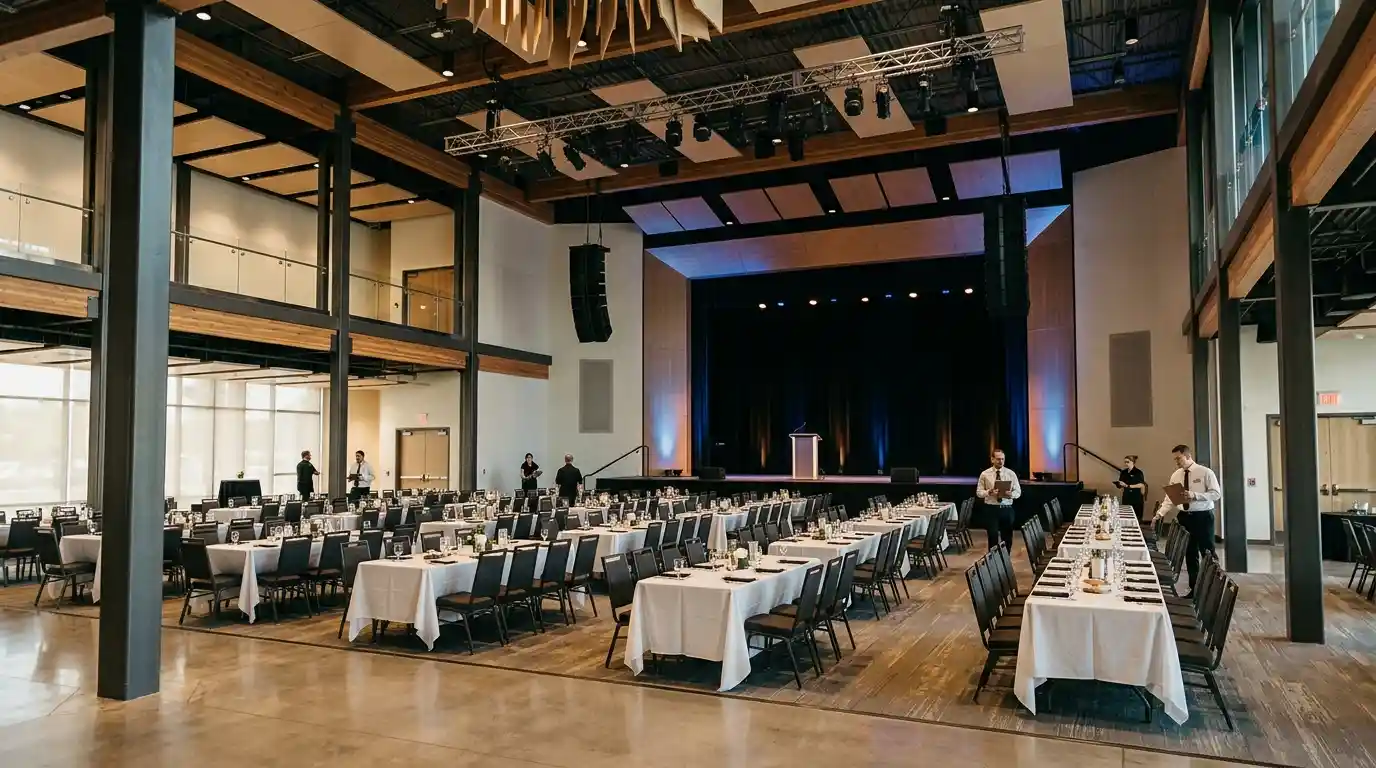
Running a successful entertainment event venue requires much more than attractive interiors, professional sound equipment, and a convenient location. Behind every memorable event is a business model that connects customer needs, operational planning, supplier relationships, marketing, and revenue generation.
This analysis uses the nine components of the Business Model Canvas to explore potential operating strategies, financial considerations, and customer experience priorities. Venue-specific services, prices, partnerships, and performance figures should be verified before being treated as confirmed facts about KIU.
What Is the Business Model Canvas for an Entertainment Venue?
The Business Model Canvas is a strategic planning framework that divides a business into nine connected areas: customer segments, value propositions, channels, customer relationships, revenue streams, key resources, key activities, key partnerships, and cost structure.
For an entertainment venue, these components help answer practical questions. Who is most likely to book the space? What makes the venue worth choosing? How will customers discover it? Which services generate income, and what expenses must be controlled?
Understanding these connections is especially important in a competitive entertainment market. The entertainment industry’s approach to growth, revenue, and innovation offers a related perspective on building flexible business strategies.
1. Customer Segments: Identifying the Right Audience
Customer segmentation is the foundation of an effective venue strategy. An event space may appeal to several audiences, but each group has different expectations, budgets, booking habits, and service requirements.
Corporate event organizers
Businesses may need spaces for conferences, employee celebrations, networking sessions, product launches, presentations, and client receptions. These customers generally value reliable scheduling, suitable layouts, professional service, and audiovisual capabilities.
Families and private celebrations
Birthday parties, anniversaries, graduations, reunions, and other milestones create opportunities for private bookings. Families often prioritize convenience, comfortable facilities, clear pricing, and enough flexibility to personalize the occasion.
Entertainment promoters and community groups
Depending on the venue’s facilities and permitted uses, additional audiences could include performers, event promoters, community organizations, and independent organizers. Their requirements may involve audience capacity, technical equipment, staffing, event scheduling, and ticketing arrangements.
A venue should evaluate these segments according to booking frequency, expected profitability, operational complexity, and available capacity rather than attempting to serve every audience equally.
2. Value Proposition: Creating an Experience Worth Booking
A venue’s value proposition explains why customers should choose it over competing locations. A room alone is rarely enough to establish a strong competitive advantage. Customers are purchasing a combination of space, convenience, service, atmosphere, and confidence that their event can run smoothly.
A compelling venue proposition may include:
- Flexible layouts for different event formats.
- Clear packages for space rental and optional services.
- Suitable sound, lighting, and presentation equipment.
- Responsive communication before and during an event.
- Transparent policies covering deposits, cancellations, and overtime.
- Accessibility, cleanliness, safety, and dependable facility management.
Not every venue needs to offer every feature. The stronger approach is to identify which benefits matter most to the target audience and deliver those benefits consistently.
For inspiration on how entertainment businesses can differentiate their experiences, explore entertainment experiences and audience engagement and the positioning strategies discussed in the Etons entertainment hub overview.
3. Channels: How Customers Discover the Venue
Even a well-equipped event venue can struggle if prospective customers cannot find it or understand what it offers. Distribution channels connect the business with customers throughout the discovery, evaluation, booking, and post-event stages.
Digital discovery channels
A professional website can present venue information, available services, capacity details, photographs, inquiry forms, and booking policies. Search engine optimization can help relevant customers discover the business when searching for event spaces and entertainment facilities in the appropriate location.
Social media can showcase room layouts, event setups, approved customer testimonials, behind-the-scenes preparation, and examples of different event formats. Paid advertising may support specific seasonal campaigns or target audiences when the expected booking value justifies the cost.
Partnership and referral channels
Event planners, caterers, photographers, decorators, entertainment providers, and corporate administrators can become valuable referral sources. Industry networking and relevant event directories may also introduce the venue to prospective customers.
Venues targeting arts and live entertainment audiences can learn from the audience-specific approach outlined in digital marketing for arts and entertainment.
The objective is not to maintain a presence on every available platform. It is to identify the channels that generate qualified inquiries and convert them into profitable bookings.
4. Customer Relationships: Turning Bookings Into Repeat Business
Customer relationships extend beyond the initial inquiry. A positive experience begins with clear communication and continues through planning, event execution, payment, and follow-up.
An effective customer relationship process can include:
- Prompt responses to booking inquiries.
- Consultations to understand the event’s requirements.
- Written proposals with itemized costs and service details.
- Regular planning updates and a confirmed event schedule.
- A designated contact for event-day coordination.
- Post-event feedback and appropriate follow-up.
Returning customers can be encouraged through repeat-booking incentives, priority scheduling where practical, and packages designed for recurring corporate or community events. Referral programs may also help attract new customers, provided their terms are clear and the associated costs are measured.
Customer retention should be evaluated using repeat-booking rates, customer satisfaction, referral inquiries, and the profitability of returning accounts. Discounts alone do not establish loyalty if service quality remains inconsistent.
5. Revenue Streams: How an Event Venue Can Earn Income
Revenue diversification can reduce dependence on a single booking category. However, additional services should be introduced only when the venue can deliver them reliably and profitably.
Core venue rental
Space rental is a potential primary revenue source. Pricing may vary according to event duration, day of the week, demand, room configuration, and the facilities included in the package.
Optional event services
Depending on the actual facilities and service agreements, supplementary income could come from audiovisual equipment, lighting packages, event coordination, furniture arrangements, decoration services, and technical support.
Catering and refreshments
Food and beverage services can improve convenience for customers when permitted and operationally feasible. A venue might provide catering directly or coordinate with external providers under clearly defined commercial arrangements.
Food-service businesses offer useful examples of how menus and service formats shape customer expectations. Relevant comparisons include the Gib’s Sports Bar menu experience, the Sea House Restaurant menu, and the Butterfields Family Restaurant menu. These are adjacent hospitality examples, not evidence that KIU provides the same services.
Recurring and premium bookings
Repeat corporate events, seasonal celebrations, private functions, and suitable entertainment programs may create additional revenue opportunities. Any membership or loyalty package should offer benefits customers genuinely value without undermining the venue’s margins.
Management should track revenue per event, average booking value, contribution margin, add-on attachment rates, and revenue by event category. These figures help distinguish attractive sales volume from sustainable profitability.
6. Key Resources: The Assets Behind Event Delivery
Key resources are the assets required to deliver the venue’s value proposition. They include physical facilities, skilled employees, technology, operating procedures, and commercial relationships.
Physical resources
The venue’s usable event space, furniture, lighting, sound equipment, storage, restrooms, access arrangements, and emergency provisions can influence which events it can accommodate. Capacity should always be determined by the applicable safety requirements and the actual configuration of the space.
People and expertise
Event coordinators, venue managers, technicians, maintenance personnel, cleaning teams, and customer-service staff help transform the physical location into a dependable service. Staffing levels should reflect event complexity and the responsibilities assigned to the venue.
Digital and operational resources
Booking software, a customer relationship management system, payment tools, inventory records, and event checklists can improve coordination. The objective is to reduce scheduling conflicts, missed requirements, administrative delays, and avoidable operational errors.
Resources should be evaluated by their contribution to customer experience, utilization, operating efficiency, and long-term financial performance.
7. Key Activities: Managing the Event Lifecycle
Key activities are the recurring tasks that keep the venue functioning. These activities begin before a customer signs a booking agreement and continue after the event concludes.
- Inquiry management: Respond to prospective customers, understand their requirements, and establish whether the event is suitable.
- Booking and scheduling: Confirm dates, contractual terms, deposits, room requirements, and supplier responsibilities.
- Event preparation: Coordinate layouts, equipment, access, staffing, deliveries, and approved decorations.
- Event execution: Manage arrivals, technical requirements, service coordination, and unexpected operational issues.
- Facility recovery: Inspect the space, complete cleaning, document damage where applicable, and prepare for the next booking.
- Performance review: Record revenue, direct costs, customer feedback, incidents, and improvement opportunities.
Standard operating procedures can make these activities more consistent. Digital checklists and shared schedules are particularly useful when several employees or third-party vendors contribute to the same event.
Operational improvements should also be connected to broader business objectives. The principles explored in digital marketing strategies for business firms and business development and growth planning can help frame the venue’s wider commercial priorities.
8. Key Partnerships: Building a Reliable Supplier Network
Partnerships can extend a venue’s capabilities without requiring it to own every asset or employ every specialist. The most useful partners fill genuine service gaps and understand the venue’s operating requirements.
Potential partners include:
- Audio, lighting, staging, and technical production companies.
- Caterers and beverage-service providers.
- Decorators, florists, and furniture rental companies.
- Photographers, videographers, performers, and entertainment providers.
- Event planners, corporate organizers, and referral partners.
- Cleaning, maintenance, security, and other operational contractors.
Every partnership should define responsibilities, pricing, availability, insurance requirements where applicable, service standards, cancellation procedures, and liability for problems. A discounted supplier is not necessarily the best choice if unreliable delivery creates expensive event-day failures.
Where food is part of the customer experience, coordination with suitable hospitality businesses can also improve convenience. For example, the Krave Restaurant Bridgeview menu overview and Sawali Grill Restaurant overview illustrate related restaurant-focused content, although any real supplier relationship would need to be established independently.
9. Cost Structure: Controlling the Expenses of Venue Operations
A venue’s financial performance depends on both revenue and the cost of delivering each booking. High sales do not automatically mean high profits, particularly when labor, equipment, maintenance, and supplier costs rise with event volume.
Fixed and recurring expenses
Depending on the ownership and operating arrangement, recurring expenses may include rent or property costs, insurance, software subscriptions, permanent staff, utilities, and routine maintenance.
Variable event expenses
Event-specific costs may include temporary staff, cleaning, catering, consumables, equipment rental, payment processing, and supplier charges. These costs should be allocated to the bookings that generate them whenever practical.
Maintenance and capital investment
Sound systems, lighting, furniture, safety equipment, and building infrastructure require upkeep. Management should budget for repairs and eventual replacement rather than treating every equipment purchase as a one-time expense.
A practical financial dashboard should monitor:
- Monthly revenue and operating expenses.
- Booking conversion rate and average booking value.
- Venue utilization and available dates.
- Contribution margin per event.
- Customer acquisition cost and repeat-booking rate.
- Cancellation rates, refunds, and overdue payments.
Comparing these measures across event types can reveal which services deserve additional investment and which require repricing or operational changes.
10. Marketing Strategy and Competitive Positioning
Marketing connects the business model to actual demand. An effective strategy should communicate the venue’s verified capabilities, make the booking process straightforward, and target customers whose requirements match the available facilities.
Build a clear online presence
The website should explain the venue’s location, event suitability, available facilities, booking process, and inquiry options. Accurate photographs and useful descriptions help prospective customers assess whether the space meets their needs.
Use search and content marketing
Search-focused pages can address relevant venue-related queries, while useful content can answer questions about planning, layouts, budgets, and event preparation. Keyword targeting should reflect the venue’s actual location and services rather than broad terms that attract unqualified traffic.
Businesses evaluating their marketing investments can also explore digital marketing return on investment, the broader impact of digital marketing, and advanced advertising and marketing strategies.
Measure results instead of relying on visibility alone
Impressions, followers, and website visits can indicate awareness, but they do not establish commercial success. More meaningful measures include qualified inquiries, site visits or tours booked, signed contracts, revenue per marketing channel, and acquisition cost.
A venue can strengthen its approach by reviewing the digital marketing ROI considerations for business services and adapting relevant measurement principles to its own booking funnel.
Potential Challenges and Risks
An entertainment venue business model must account for risks that can affect both customer satisfaction and profitability.
- Seasonal demand: Some periods may generate more bookings than others, making cash-flow planning important.
- Scheduling conflicts: Inaccurate calendars or unclear access times can disrupt event preparation.
- Cost overruns: Unplanned labor, supplier changes, equipment failures, and overtime can reduce margins.
- Safety and compliance: Capacity, emergency access, accessibility, food handling, noise, and permits must be addressed according to applicable requirements.
- Reputation risks: Poor communication or inconsistent service can affect reviews and referrals.
- Overdependence on one segment: A narrow customer base can expose the business to changes in demand.
Risk management should be part of everyday operations. Clear contracts, documented procedures, appropriate insurance, reliable suppliers, contingency plans, and accurate financial records can reduce avoidable disruptions.
How to Evaluate the KIU Entertainment Event Venue Business Model
The Business Model Canvas becomes most useful when each component is supported by evidence. A practical assessment should distinguish between what is known about the venue and what remains a strategic possibility.
- Verify the offer: Confirm the available facilities, capacity, event types, service packages, and operating arrangements.
- Identify priority customers: Compare audience needs, booking frequency, profitability, and operational fit.
- Review the booking funnel: Measure inquiries, qualified leads, tours, proposals, conversions, and cancellations.
- Calculate event-level profitability: Compare collected revenue with the direct costs of delivering each event.
- Assess supplier performance: Track reliability, service quality, pricing, and contingency coverage.
- Prioritize improvements: Invest first in changes that address verified customer problems or measurable operating weaknesses.
This approach avoids confusing a theoretical business model with confirmed company performance. It also provides a repeatable method for testing new packages, marketing channels, and operational improvements.
Conclusion
The KIU Entertainment Event Venue business model can be analyzed through nine interconnected components: customer segments, value propositions, channels, customer relationships, revenue streams, key resources, key activities, key partnerships, and cost structure.
Together, these components provide a structured way to evaluate how an entertainment venue attracts customers, delivers memorable experiences, manages its operations, and generates sustainable revenue.
The strongest strategy is not necessarily to offer the greatest number of services. It is to understand the target market, communicate a clear value proposition, deliver events consistently, control costs, and measure the financial results of each major decision.
For KIU specifically, the next step is to validate the venue’s actual facilities, service offering, pricing, and customer demand before drawing conclusions about its competitive position or profitability. A carefully maintained Business Model Canvas can then become a practical tool for planning growth and improving long-term performance.