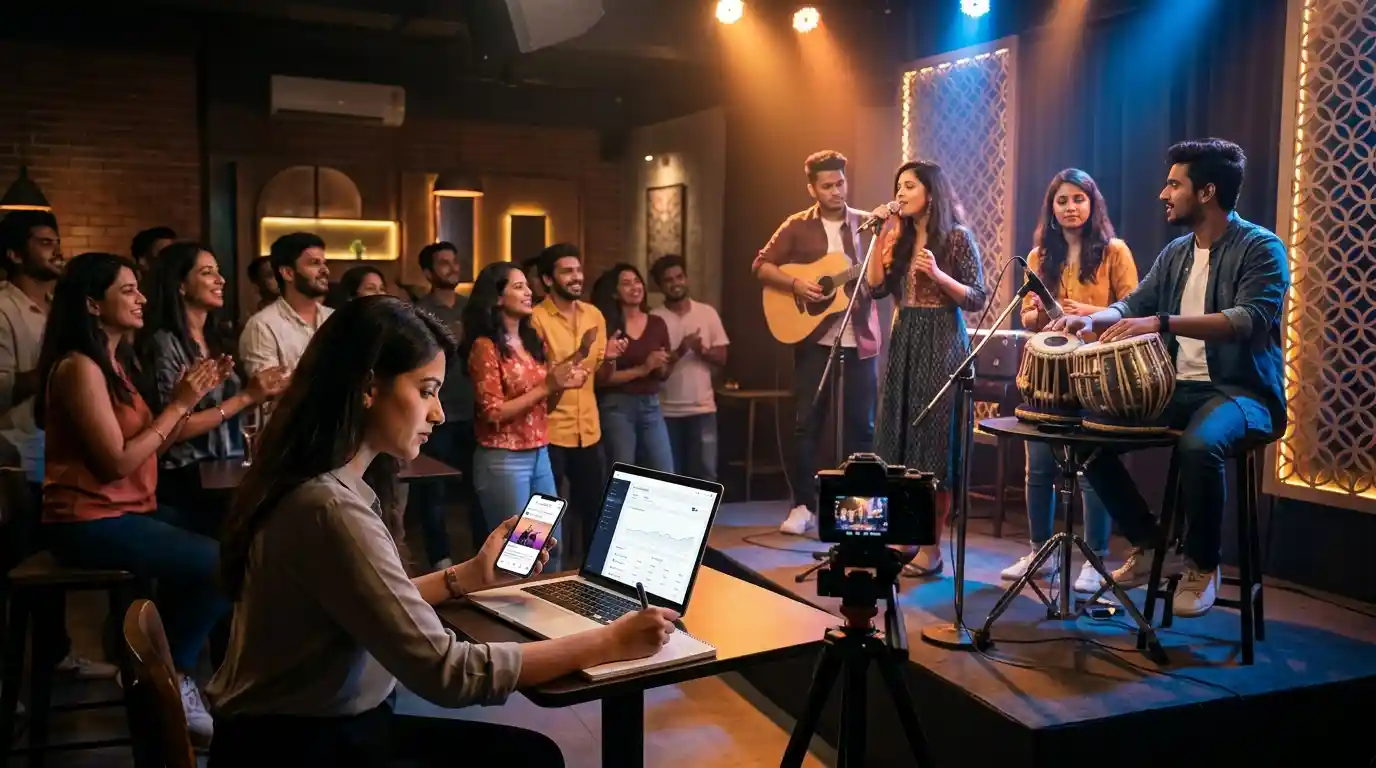
Hyderabad’s arts, entertainment, and music industries operate at the intersection of cultural heritage, creative talent, live experiences, and digital innovation. From independent musicians and visual artists to event organizers, production studios, cultural venues, and entertainment businesses, creative professionals have new opportunities to reach audiences beyond their immediate neighborhoods. Digital marketing helps connect these businesses with potential customers, promote cultural experiences, and develop more sustainable revenue streams.
The economic impact extends beyond online visibility. A well-planned digital campaign can help an artist sell tickets, enable a venue to attract more visitors, connect a production company with commercial partners, and give emerging performers opportunities to build loyal audiences. However, these outcomes depend on campaign quality, audience demand, pricing, and the ability to convert online attention into measurable business results.
Understanding the relationship between digital marketing and Hyderabad’s creative economy requires looking at audience discovery, revenue generation, employment, technology adoption, and the challenges that smaller creative businesses face when competing for attention.
How Digital Marketing Is Changing Hyderabad’s Creative Economy
Traditional promotion has long played an important role in arts and entertainment. Posters, newspaper listings, radio promotions, personal recommendations, and partnerships with local venues can still be useful. Digital channels add another layer by allowing creative businesses to communicate directly with audiences before, during, and after an event.
Search engines help people discover performances, exhibitions, workshops, and entertainment services when they are actively looking for something to attend. Social platforms introduce artists to people who may not already know their work. Video content allows musicians and performers to demonstrate their abilities, while email and messaging campaigns help maintain relationships with previous customers.
This shift reflects broader developments discussed in the global impact of digital marketing. For Hyderabad’s creative businesses, the practical opportunity is to use digital channels to reduce dependence on a single promotional method and create a more consistent path from discovery to purchase.
Reaching audiences beyond local boundaries
A visual artist can showcase a collection to potential buyers in other cities, while a music producer can distribute recordings to listeners in different regions. Event organizers can attract visitors who are planning trips to Hyderabad, and performing arts groups can use video to introduce their work to audiences who cannot attend in person.
Digital distribution does not automatically produce sales or international recognition. Artists still need compelling work, clear communication, reliable delivery, and a strong understanding of their intended audience. Nevertheless, online discovery can widen the potential market without requiring every interaction to begin with a physical visit.
The Role of Social Media in Arts, Entertainment, and Music Promotion
Social media gives creative professionals an accessible way to present their work, communicate with followers, and promote upcoming activities. Instagram can support visual portfolios and short performance clips. YouTube can host music videos, interviews, demonstrations, and longer recordings. Other social platforms can help businesses share announcements, answer questions, and encourage audiences to recommend experiences to their networks.
The most effective approach is not simply to publish more frequently. Content should give people a reason to pay attention and take a useful next step.
- Musicians: Share rehearsal footage, original recordings, performance highlights, release announcements, and ticket information.
- Visual artists: Publish studio processes, collection previews, exhibition announcements, and explanations of individual works.
- Event organizers: Promote performers, explain event formats, share practical visitor information, and publish approved highlights from previous events.
- Production companies: Showcase completed projects, behind-the-scenes work, technical capabilities, and client-approved case studies.
- Cultural organizations: Explain the significance of performances, introduce participating artists, and encourage community involvement.
Entertainment businesses can also learn from broader approaches to entertainment experiences and audience engagement. The central principle is to build a relationship with an audience rather than treating every post as an isolated advertisement.
Search Engine Optimization and Local Audience Discovery
Search engine optimization helps arts and entertainment businesses appear when people search for relevant performances, creative services, music lessons, exhibitions, venues, and cultural activities. A clear website can answer questions that social posts often leave unresolved, including dates, ticket prices, venue details, booking procedures, accessibility information, and contact options.
For businesses serving specific neighborhoods or areas of Hyderabad, locally relevant website content can improve the usefulness of their online presence. Accurate business details, descriptive page titles, clear service information, and a well-maintained business profile can help potential customers understand whether an event or service suits their needs.
Creative businesses should avoid publishing dozens of nearly identical pages that differ only by location or keyword. Useful content is more likely to support long-term visibility when it reflects real services, events, audiences, and expertise.
These principles connect with wider digital marketing strategies for business firms and the role of modern advertising and marketing practices in helping organizations communicate their value.
How Digital Marketing Creates Revenue Opportunities
Digital marketing can contribute to revenue through several channels, but the appropriate mix depends on the creative business model. A concert organizer may prioritize ticket sales, while an artist may focus on commissions, artwork sales, licensing, or workshop bookings. A recording studio may use digital campaigns to generate qualified inquiries for production and mixing services.
Ticket sales and event attendance
Event campaigns can introduce an experience, explain what attendees can expect, and direct interested people to a booking page. Early announcements build awareness, performer introductions provide additional reasons to attend, and timely reminders help interested customers complete their purchases.
Campaigns should provide accurate information about dates, locations, pricing, age restrictions where applicable, and ticket availability. If an event changes, organizers should communicate the update promptly across the channels they use.
Music streaming, digital distribution, and merchandise
Musicians can use short-form videos, artist profiles, mailing lists, and release campaigns to encourage listeners to explore their catalogs. Digital attention may also support merchandise sales, paid performances, licensing inquiries, and collaborations.
Streaming activity should not be confused with guaranteed income. Revenue varies according to platform arrangements, rights ownership, distribution agreements, audience behavior, and other factors. Artists need to understand their costs and rights before treating audience growth as a reliable financial outcome.
Developments in music technology and modern audio production also create opportunities for studios, sound engineers, producers, and independent creators to demonstrate specialized skills and attract suitable clients.
Art sales, commissions, and creative services
Artists can use online portfolios to show available work, explain commission processes, and answer common questions about materials, dimensions, delivery, and pricing. Clear product pages and professional photographs help prospective buyers evaluate a piece before making an inquiry.
For creative service providers, the goal is to attract suitable customers rather than maximize traffic alone. A smaller audience of people actively looking for commissioned artwork, event photography, sound production, or design services may be more commercially valuable than a large audience with little purchase intent.
Measuring the Return on Digital Marketing Investment
Digital campaigns can generate substantial activity without necessarily producing profitable results. Hyderabad’s creative businesses should therefore establish measurable objectives before allocating money to advertising, content production, influencer partnerships, or marketing software.
Useful performance indicators include:
- Audience reach: The number of people exposed to a campaign.
- Engagement: Meaningful interactions such as comments, saves, shares, and video completion.
- Website traffic: Visits to relevant event, portfolio, service, or booking pages.
- Conversion rate: The proportion of relevant visitors who complete a defined action.
- Cost per acquisition: The marketing cost associated with generating a customer, booking, or ticket sale.
- Revenue attributed to campaigns: Sales that can reasonably be connected to specific marketing activities.
- Repeat business: Returning customers, repeat bookings, and continued participation.
A practical starting point is to calculate return on marketing investment using attributable revenue and campaign costs. For a simple revenue-based calculation, subtract campaign cost from attributable revenue and divide the result by campaign cost. Multiply by 100 to express it as a percentage. This measure does not include every business expense, so it should not be mistaken for net profit.
Businesses seeking a broader measurement framework can explore strategic analysis of digital marketing ROI and digital marketing’s impact on business enterprises. These related topics provide a wider business context for evaluating digital investment.
Employment and Growth Across Hyderabad’s Creative Supply Chain
As creative businesses expand their digital activity, they may need additional support with video editing, graphic design, copywriting, website development, search optimization, advertising, event coordination, photography, and audience management. This can create work for freelancers, agencies, production teams, and specialist service providers.
Event promotion can also support businesses around a performance or exhibition. Depending on the event and its audience, increased attendance may create opportunities for venues, hospitality providers, transport services, equipment suppliers, caterers, and local vendors.
These effects are not automatic, and their scale varies by project. A successful campaign may generate new work, but a poorly targeted campaign can consume a limited budget without producing sufficient sales. Sustainable growth depends on matching marketing investment with real demand and operational capacity.
Businesses can compare these considerations with broader approaches to scaling consumer products and services through digital marketing and using digital marketing to support technology businesses.
The Importance of Content Marketing and Storytelling
Arts and entertainment businesses have a natural advantage in content marketing because their work often has a visual, musical, educational, or emotional dimension. Rather than relying entirely on promotional messages, they can publish material that helps audiences understand the people, skills, ideas, and processes behind a creative experience.
Useful formats include artist interviews, rehearsal diaries, production explainers, exhibition previews, short documentaries, event recaps, and educational articles. Each format should serve a purpose and guide readers toward a relevant action, such as exploring a portfolio, attending a performance, subscribing to updates, or requesting a booking.
Content can also extend the life of a live event. Approved photographs, interviews, and performance highlights can keep an audience engaged after the venue closes and help introduce future events to people who missed the original experience.
Businesses developing a broader publishing strategy may benefit from studying the wider business impact of digital marketing and the role of planning for growth in the entertainment industry.
Paid Advertising, Influencer Partnerships, and Collaboration
Paid advertising can help a campaign reach a defined audience within a limited period. For example, an event organizer might promote a concert to people interested in a relevant music genre, while an art gallery might advertise an exhibition to potential visitors in selected areas. Campaign settings should be based on the event’s actual audience and commercial objectives.
Influencer collaborations can introduce an artist or event to a community that already trusts a creator’s recommendations. However, follower counts alone do not establish commercial value. Audience relevance, genuine engagement, content quality, campaign costs, and measurable results all matter.
Partnerships can also extend beyond social media personalities. Venues, educational organizations, hospitality businesses, creative studios, and event producers may collaborate on promotions when their audiences and objectives align. Any commercial partnership should clearly communicate its terms and avoid misleading promotional claims.
For a wider perspective on advertising and campaign planning, related reading includes advanced digital advertising and marketing and digital marketing strategy development.
Challenges Facing Small Arts and Entertainment Businesses
Although digital platforms lower some barriers to promotion, they do not remove every obstacle. Independent artists and small entertainment companies often operate with limited budgets, irregular income, and competing demands on their time.
- Budget constraints: Advertising, production equipment, software, and professional creative support can require upfront investment.
- Skills gaps: Business owners may need training in analytics, search optimization, campaign planning, and content production.
- Platform dependence: Changes to algorithms, account access, or advertising costs can affect visibility.
- Audience competition: Numerous artists and entertainment businesses compete for limited attention.
- Unclear measurement: Likes and views can look encouraging without translating into bookings or revenue.
- Inconsistent publishing: Creative teams may struggle to maintain marketing activity while delivering their core work.
- Rights and permissions: Music, images, performances, and recordings may require appropriate permissions before commercial distribution.
A manageable plan is usually more useful than an elaborate strategy that a small team cannot maintain. Businesses can begin with one well-designed website or landing page, a small number of relevant social channels, consistent event information, and a basic method of tracking inquiries and sales.
They should also retain control of important business assets, including domain names, customer records obtained with appropriate consent, original creative files, and campaign data where available. This reduces dependence on any single platform.
Artificial Intelligence and the Future of Creative Marketing
Artificial intelligence and automation can assist with repetitive marketing tasks, including drafting content outlines, organizing campaign data, generating initial creative concepts, and identifying patterns in audience behavior. Used carefully, these tools may help small teams work more efficiently and spend more time on artistic development and customer relationships.
Automation should not replace human judgment. Creative businesses need to review generated content for accuracy, protect confidential information, respect intellectual property, and ensure that public communications reflect their actual work. Generic or misleading content can weaken trust rather than improve engagement.
Data analysis can also help businesses compare campaign performance, identify useful audience segments, and decide which channels deserve further investment. These capabilities are most valuable when they support a clear commercial or cultural objective rather than being adopted simply because the technology is available.
Related discussions of technology developments and digital media and the importance of reliable digital platforms offer additional context for organizations building technology-dependent marketing operations.
A Practical Digital Marketing Roadmap for Hyderabad’s Creative Businesses
Artists, musicians, venues, and entertainment companies can build a realistic marketing plan by prioritizing the steps most likely to support their goals.
- Define the audience: Identify who is most likely to attend an event, buy artwork, stream music, or purchase a creative service.
- Set a measurable objective: Choose a target such as ticket sales, qualified inquiries, portfolio visits, or repeat bookings.
- Build a reliable destination: Create a website or landing page with clear descriptions, pricing where appropriate, contact details, and booking information.
- Choose suitable channels: Use search, social media, video, email, or paid advertising according to audience behavior and available resources.
- Publish useful content: Share authentic creative work, practical information, and stories that help audiences understand the value of the experience.
- Track the customer journey: Measure how people move from discovering content to making inquiries, booking tickets, or completing purchases.
- Review the economics: Compare campaign spending with attributable sales, contribution margins, and repeat business.
- Improve gradually: Continue the activities that perform well, test changes carefully, and discontinue spending that does not justify its cost.
For businesses operating across multiple markets or service categories, related articles on digital marketing ROI across industries, digital marketing and retail performance, and digital marketing’s economic role in e-commerce can provide additional business perspectives. Their lessons should be adapted to Hyderabad’s own audiences, costs, and creative sectors rather than applied without evaluation.
Conclusion: Building a More Sustainable Creative Economy
Digital marketing can help Hyderabad’s arts, entertainment, and music businesses improve discoverability, develop stronger audience relationships, promote events, and explore additional revenue opportunities. It can also create demand for supporting services across content production, design, advertising, technology, and event operations.
Its economic contribution depends on more than reach or engagement. Creative quality, audience relevance, operational reliability, fair commercial practices, and financial discipline determine whether digital activity produces lasting value. Businesses that connect marketing decisions with measurable objectives can make better use of limited resources while protecting the integrity of their work.
For Hyderabad’s creative community, the strongest long-term approach is to combine the city’s artistic talent and cultural diversity with thoughtful digital communication. That combination can help independent creators and established organizations reach new audiences, strengthen commercial resilience, and make creative experiences accessible to more people.