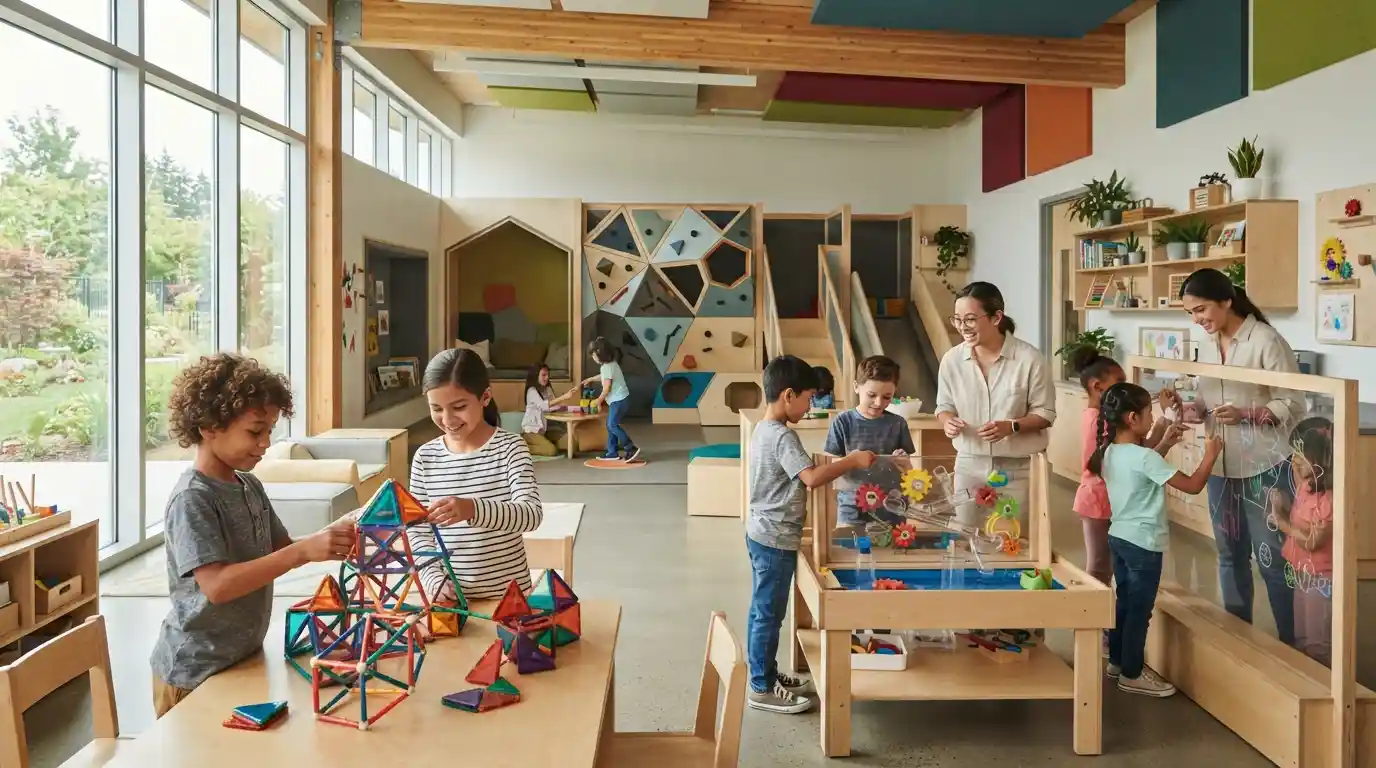
As education continues to evolve, families and educators are increasingly interested in learning environments that encourage curiosity rather than passive memorization. Interactive spaces can combine play, creativity, technology, movement, and structured activities to create experiences that make learning feel more natural and engaging.
An effective education playground is therefore much more than a recreational area. It can become a learning environment where children develop cognitive skills, communication abilities, confidence, creativity, and practical problem-solving skills while enjoying the process.
What Is an Education Playground?
An education playground is a learning-focused environment designed around exploration, interaction, and hands-on activities. Instead of separating education from play, these spaces combine the two so learners can discover concepts through practical experiences.
Depending on the environment, an education playground may include interactive exhibits, building activities, science experiments, creative stations, storytelling areas, puzzles, technology-based experiences, role-playing zones, or physical challenges.
The central idea is simple: children are encouraged to participate rather than simply receive information.
This approach fits naturally within the broader evolution of modern education, where learning increasingly involves creativity, collaboration, practical skills, and experiences that connect classroom concepts with everyday life.
Why Interactive Learning Environments Matter
Traditional instruction still has an important place in education, but learners do not all respond to information in exactly the same way. Some understand concepts more effectively when they can see them, touch them, build something, discuss an idea, or experiment with a solution.
An education playground creates opportunities for these different forms of engagement.
Instead of asking a child to memorize a concept, an interactive activity may allow that child to discover how the concept works. Instead of explaining teamwork only through a lesson, a group challenge can make cooperation part of the learning experience.
This can make learning more memorable while encouraging children to become active participants in their own development.
Education Playground and Play-Based Learning
Play is a natural way for children to explore their surroundings. When educational goals are incorporated into carefully designed play experiences, children can practice skills without feeling that every activity is another formal assignment.
For example, a construction challenge can introduce basic engineering concepts. A sorting game can strengthen logical thinking. A storytelling activity can encourage language development. A collaborative puzzle can require communication and patience.
This connection between learning and enjoyable experiences is also reflected in the ideas explored in Educate and Celebrate, where learning becomes more memorable when creativity and participation are part of the experience.
The goal is not to eliminate structured education. Instead, play-based activities can complement formal instruction by giving learners additional opportunities to apply what they know.
Building Curiosity Through Exploration
Curiosity is one of the strongest drivers of learning. When children encounter something unfamiliar, they naturally want to understand how it works.
An education playground can intentionally create these moments of discovery.
A child might encounter a mechanical structure and wonder why it moves. Another might experiment with different materials to build a stable tower. Someone else might use an interactive display to explore a historical event or scientific concept.
These experiences encourage children to ask questions instead of simply waiting for answers.
That mindset can support long-term learning because curiosity encourages learners to investigate subjects independently. It also connects with the broader concept of lifelong learning, where education continues beyond a particular classroom, grade, or age.
How an Education Playground Supports STEM Learning
Science, technology, engineering, and mathematics can sometimes appear abstract when taught only through theory. Interactive environments provide opportunities to make these subjects more tangible.
A STEM-focused education playground might include building challenges, simple machines, measurement activities, coding exercises, pattern games, science demonstrations, or problem-solving stations.
For example, children could be asked to construct a bridge that supports a particular amount of weight. The activity introduces engineering principles while encouraging experimentation. If the structure fails, learners can modify the design and try again.
This trial-and-improvement process teaches an important lesson: mistakes can be part of learning.
Readers interested in broader scientific and technology topics can also explore the site’s Science and Technology sections for additional perspectives on these fields.
Technology in Modern Education Playgrounds
Technology can make an education playground more interactive, but it should serve the learning experience rather than dominate it.
Touchscreens, projection systems, motion-sensitive activities, augmented reality, educational games, and interactive displays can provide additional ways for learners to engage with information.
However, technology works best when it encourages exploration, discussion, movement, and problem-solving rather than simply replacing one passive screen with another.
A balanced environment may combine digital activities with physical construction, creative work, group challenges, reading, and conversation.
This balance is particularly important because education is ultimately about developing capable people, not simply teaching children how to operate devices.
Creativity and the Role of Art
Creative activities can play a major role in an education playground. Art stations, design challenges, storytelling areas, music activities, and imaginative role-play can help learners communicate ideas in different ways.
A child who struggles to explain an idea verbally may be able to express it through drawing or building. Another learner may discover an interest in design by creating a model or visual project.
Creative education also teaches learners that there can be multiple ways to approach a problem.
This makes an education playground a natural bridge between academic learning and creative development. For additional inspiration around creative subjects, explore the site’s Art & Design coverage.
Developing Social and Communication Skills
Learning is not always an individual activity. Children also need opportunities to communicate, negotiate, cooperate, listen, and resolve disagreements.
Education playgrounds can create these opportunities through group-based activities.
A team construction challenge, for instance, may require children to divide responsibilities and agree on a strategy. A role-playing activity can encourage participants to understand different perspectives. A shared puzzle can teach patience and communication.
These experiences can help children understand that successful collaboration requires more than simply working beside another person.
They must listen to ideas, explain their own thinking, compromise when necessary, and contribute toward a shared goal.
Supporting Different Learning Styles
One of the strengths of an interactive environment is its ability to offer different ways of engaging with a subject.
Some learners may prefer visual information. Others may respond more strongly to movement, conversation, practical tasks, experimentation, or creative activities.
A well-designed education playground can provide a combination of these experiences rather than relying on a single instructional method.
This flexibility can also complement specialized approaches to education. For example, families researching individualized learning support may find the discussion around a Special Education Associate Degree useful for understanding the wider field of special education and learner support.
The goal is not to label every child according to one learning style, but to create varied experiences that give learners multiple ways to participate.
The Role of Educational Specialists
Interactive learning environments can become even more effective when educators understand how children learn and where additional support may be needed.
Teachers, facilitators, counselors, and educational specialists can observe how learners respond to activities and help guide them toward productive challenges.
An educational diagnostician, for example, works within the broader educational support system to help understand student needs and learning challenges.
While an education playground is not a substitute for professional assessment or formal schooling, observations made during interactive activities can help educators recognize interests, strengths, and areas where additional encouragement may be beneficial.
Connecting Education With Real-World Skills
One of the most valuable aspects of experiential learning is the opportunity to connect knowledge with real-world situations.
Children can practice planning, decision-making, communication, creativity, organization, and problem-solving through activities that resemble real challenges.
A simulated business activity might introduce budgeting and teamwork. A design project can involve planning and measurement. A science challenge can require observation and testing. A community-focused activity can encourage empathy and communication.
These experiences can help learners understand why education matters outside the classroom.
They also connect with broader discussions about North American education and the changing expectations placed on modern learners.
Education Playground and Lifelong Learning
The benefits of interactive education do not have to stop when a child leaves the playground.
A positive learning experience can influence how people approach new subjects later in life. When learners associate discovery with curiosity and experimentation, they may become more willing to ask questions and explore unfamiliar ideas.
This is especially important in a world where knowledge and technology continue to change.
Education increasingly extends beyond traditional academic milestones. People learn through schools, workplaces, communities, hobbies, digital platforms, travel, and personal projects.
An education playground introduces this broader idea early: learning can be active, enjoyable, practical, and continuous.
Safety Should Be Part of the Learning Experience
An engaging learning environment must also be a safe one.
Play structures, equipment, pathways, interactive technology, and activity areas should be designed with appropriate safety considerations. Children should also receive clear instructions before participating in activities that involve movement, tools, equipment, or group challenges.
Supervision is equally important. Adults can help children understand boundaries, encourage respectful behavior, and intervene when an activity creates unnecessary risk.
Safety does not have to make a playground boring. In fact, a well-organized environment can allow children to explore confidently because expectations are clear.
Families interested in wider child-focused topics can also explore the site’s Kids content for additional ideas and perspectives.
Creating Inclusive Education Playgrounds
An effective education playground should aim to welcome learners with different abilities, interests, backgrounds, and levels of confidence.
Accessibility can involve physical design, activity instructions, sensory considerations, communication methods, and flexible participation options.
For some children, a quieter activity area may make participation easier. Others may benefit from adaptive equipment or additional time to complete a challenge.
Inclusive design does not mean creating identical experiences for everyone. It means giving different learners meaningful opportunities to participate.
This approach can also encourage children to understand differences, practice empathy, and appreciate the strengths that other people bring to a group.
Parents and Educators as Learning Partners
The strongest education playground experiences often involve adults as facilitators rather than simply supervisors.
Instead of immediately providing an answer, an adult can ask questions such as:
- What do you think will happen?
- Why do you think that happened?
- What could you change?
- Can you find another solution?
- How could you explain your idea to someone else?
These questions encourage reflection and help children think about the process behind their actions.
Parents can also continue conversations after the activity. A simple discussion at home about what a child built, discovered, or enjoyed can reinforce the experience and encourage further curiosity.
How Education Playgrounds Can Complement Traditional Schools
An education playground should not necessarily be viewed as an alternative to school. Instead, it can complement formal education by giving learners additional opportunities to apply concepts in practical settings.
A classroom lesson about ecosystems could be followed by a hands-on environmental activity. A mathematics lesson could connect with a measurement challenge. A history unit could inspire an interactive storytelling experience.
This relationship creates a bridge between theoretical knowledge and practical application.
For a broader look at educational systems and opportunities, readers can also explore North American Education and Whetstone Education.
Designing a Better Education Playground
Good design begins with a clear understanding of the learners who will use the space.
Rather than filling an area with as many activities as possible, designers can create purposeful zones with different educational goals.
A balanced education playground might include:
- A discovery area for exploration and experimentation.
- A STEM zone for building and problem-solving.
- A creative area for art and design.
- A reading or storytelling space.
- A collaborative area for group challenges.
- A technology zone for guided digital activities.
- A movement area that combines physical activity with learning.
- A quiet space for reflection and independent work.
This type of structure allows children to move between different forms of engagement without making the environment feel disorganized.
Learning Beyond the Playground
The most successful education playgrounds do not make children dependent on one specific space for learning. Instead, they encourage habits that can continue elsewhere.
A child who learns to test ideas in a playground can apply the same mindset to a school project. Someone who discovers a passion for building may begin exploring engineering concepts independently. A learner who enjoys storytelling may become more interested in reading and writing.
Learning becomes a process of asking questions, experimenting, reflecting, and trying again.
That is why educational environments should focus not only on delivering information but also on developing confident and curious learners.
Why the Education Playground Model Is Becoming More Relevant
Modern education increasingly recognizes that knowledge alone is not enough. Learners also need creativity, adaptability, communication, critical thinking, collaboration, and practical problem-solving abilities.
Interactive learning environments can bring several of these skills together in a single experience.
They also reflect the broader movement toward more engaging educational experiences. From technology-enhanced classrooms to community learning programs and creative workshops, education is becoming increasingly connected with real-world participation.
For readers interested in the broader relationship between education and digital transformation, the site’s article on digital marketing and the education landscape offers another perspective on how modern educational environments are influenced by changing technologies and industries.
Final Thoughts
An education playground represents a simple but powerful idea: learning can happen through discovery, movement, creativity, experimentation, and collaboration.
When thoughtfully designed, these environments can help children connect academic concepts with practical experiences while developing communication, problem-solving, creativity, confidence, and curiosity.
The most valuable outcome is not simply that a child completes an activity. It is that the child becomes interested in asking what comes next.
That curiosity can become the foundation for stronger learning habits throughout school and beyond. Whether the experience involves science, technology, art, storytelling, construction, movement, or teamwork, an education playground can turn learning into something children actively want to explore.
As education continues to evolve, spaces that combine purposeful learning with meaningful experiences may become an increasingly important part of how learners discover their abilities and prepare for the future.