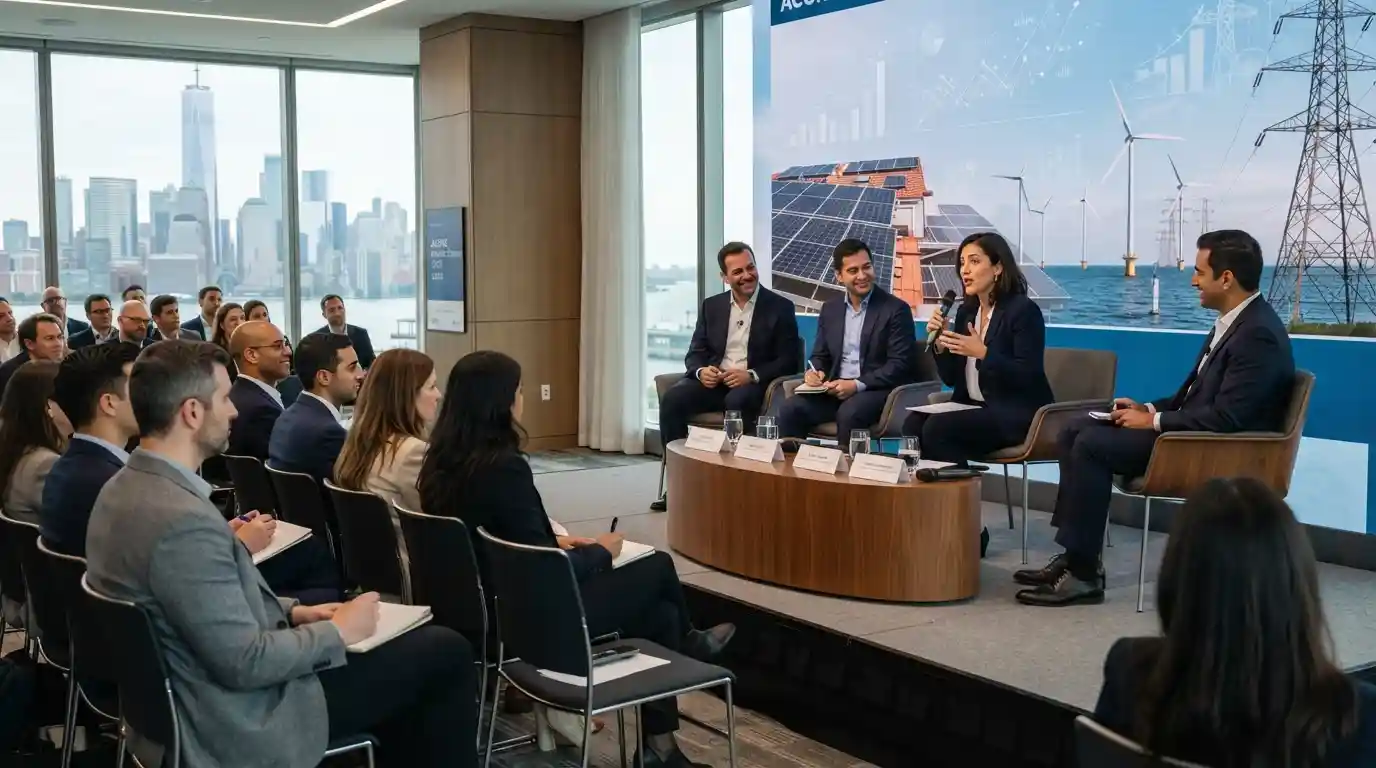
For professionals following financial markets, the event provides a useful lens into how traditional finance is adapting to large-scale infrastructure and clean-energy opportunities. Its discussions also connect with broader themes such as digital transformation, investment risk, capital allocation, and sustainable finance.
What Was the ACORE Finance Forum 2025?
The ACORE Finance Forum is an industry event organized by the American Council on Renewable Energy (ACORE). The 2025 edition took place in New York City on June 4 and 5 and brought together participants from across the clean-energy finance ecosystem.
The event was designed around the financial architecture required to support expanding clean-energy deployment. Participants included banking institutions, private equity firms, asset managers, developers, manufacturers, and corporate buyers.
The forum’s audience reflected the increasingly interconnected nature of energy, finance, technology, and infrastructure. Understanding that connection is important for anyone researching digital marketing ROI and strategic business analysis, because modern investment decisions increasingly depend on data, market intelligence, technology, and long-term business planning.
Why the 2025 Finance Forum Mattered
Clean-energy finance has become more complex as projects grow larger and electricity demand changes. Investors must consider project economics, financing structures, policy conditions, supply chains, technology, corporate demand, and potential market risks at the same time.
The ACORE Finance Forum provided a setting where these issues could be discussed from multiple perspectives rather than viewed only through the lens of traditional banking or investment management.
This broader perspective is particularly relevant to businesses evaluating digital transformation in financial services. Financial organizations increasingly need technology and data capabilities that allow them to evaluate opportunities, manage risk, communicate with stakeholders, and respond to changing markets.
Major Financial Themes From ACORE Finance Forum 2025
1. Growing Demand for Clean-Energy Capital
One of the central issues surrounding clean-energy investment is the amount of capital required to build and expand infrastructure. Renewable generation, storage, transmission, and supporting infrastructure can require significant upfront investment.
As electricity demand grows, financing discussions become increasingly important. Investors need to understand not only whether individual projects are financially viable, but also how portfolios of projects can be financed and managed over time.
This makes broader financial-growth strategies relevant as well. Businesses researching financial growth and investment opportunities can use the clean-energy market as an example of how capital requirements can create new financial structures.
2. Changing Capital Structures
Large infrastructure projects rarely rely on a single source of funding. Developers and investors may consider combinations of equity, debt, tax-related structures, corporate capital, and other financing mechanisms.
The result is a more sophisticated capital stack. Understanding the relationship between these funding sources is important because changes in interest rates, policy, project risk, and investor expectations can affect the economics of a transaction.
The same principle applies across other industries. Companies exploring equipment financing or consumer and home financing also need to evaluate financing costs, repayment structures, cash flow, and the underlying economics of an investment.
3. Equity Investment and Investor Sentiment
Equity investment was another important component of the 2025 discussions. Equity investors can provide capital for projects and businesses while accepting a different risk and return profile from lenders.
Investor sentiment can change as market conditions develop. Factors such as energy demand, technology costs, regulatory developments, corporate commitments, and expected returns can all influence how investors assess opportunities.
This is why investment analysis should focus on underlying fundamentals rather than relying solely on market enthusiasm. Similar considerations apply to emerging financial technologies and digital assets, including topics covered in cryptocurrency and digital scarcity.
4. Debt Financing and New Financing Structures
Debt remains an important part of infrastructure finance because projects often require substantial amounts of capital before they begin generating long-term revenue.
Debt financing requires careful consideration of interest rates, repayment schedules, collateral, project risk, contractual arrangements, and expected cash flows. For clean-energy projects, these factors can become especially important because development timelines and market conditions can vary.
Understanding debt is also useful when examining specialized financing products such as vehicle financing. Although the underlying markets are different, both involve evaluating affordability, risk, repayment terms, and long-term financial consequences.
5. The Influence of Large Energy Buyers
Large corporate energy users are increasingly important participants in the clean-energy ecosystem. Technology companies, manufacturers, data-center operators, and other major electricity consumers can influence investment decisions because their energy requirements can affect demand forecasts.
Growing electricity consumption creates opportunities for new generation and infrastructure, while also creating financing questions around how quickly supply can be developed.
This relationship between technology and finance is part of a broader trend toward interconnected business models. Companies can also examine digital commerce and business transformation to understand how technology can reshape established markets.
6. International Investment Trends
Clean-energy investment is not limited to one market. Capital can move across borders, while developers, financial institutions, infrastructure companies, and investors evaluate opportunities in different jurisdictions.
International investment introduces additional considerations, including currency exposure, regulatory differences, political conditions, supply-chain issues, taxation, and local market structures.
For businesses evaluating international opportunities, financial analysis should therefore be combined with market research and strategic planning. This approach also applies to organizations studying the global impact of digital marketing and other cross-border business activities.
Technology and the Future of Finance
Technology continues to change how financial decisions are made. Data analytics, automation, artificial intelligence, digital platforms, and improved reporting tools can help organizations process information more efficiently.
However, technology does not eliminate the need for financial judgment. Investors and executives still need to understand assumptions, evaluate risk, verify information, and consider how changing conditions could affect an investment thesis.
The intersection of finance and technology is also visible in digital-asset markets. Topics such as digital payments and cryptocurrency demonstrate how technology can influence financial products and consumer behavior.
Businesses interested in technology-led growth can also explore modern technology solutions for businesses as part of a broader digital transformation strategy.
Risk Management in Clean-Energy Finance
Investment opportunities always involve risk, and infrastructure finance is no exception. A project may be affected by construction delays, changing costs, regulatory developments, interest rates, technology performance, supply-chain disruptions, or shifts in market demand.
Effective risk management begins with identifying the factors that could affect project economics. Investors can then evaluate different scenarios and determine whether expected returns adequately compensate for potential risks.
Financial risk management is also important in specialized insurance markets. Businesses evaluating excess insurance and business risk protection can see how financial planning often extends beyond investments to include protection against unexpected losses.
Policy and Regulation as Financial Factors
Government policy can have a significant effect on clean-energy economics. Tax incentives, regulations, permitting processes, trade policies, and other government decisions can influence project costs and expected returns.
For investors, this means financial analysis cannot always be separated from policy analysis. A change in the regulatory environment can affect the assumptions used in a project model.
The lesson extends beyond energy finance: businesses operating in regulated industries should continually monitor policy developments and consider how regulatory changes could affect revenue, costs, investment requirements, and strategic plans.
How Businesses Can Apply the Forum’s Broader Lessons
Focus on Long-Term Capital Planning
Businesses should evaluate financing requirements over a longer time horizon rather than focusing only on immediate funding needs. Long-term planning can help organizations understand how capital expenditures, operating costs, debt obligations, and growth investments interact.
Use Multiple Scenarios
Financial planning is stronger when it considers multiple possible market conditions. Companies can model changes in interest rates, demand, costs, investment timelines, and revenue expectations to understand where vulnerabilities may exist.
Connect Finance With Business Strategy
Finance should support strategic decision-making rather than operate separately from the rest of the organization. Investment decisions should connect with business objectives, operational requirements, customer demand, and long-term growth plans.
Organizations interested in improving this connection can also review digital marketing strategies for business firms, since marketing, finance, operations, and technology increasingly influence one another.
Monitor Emerging Technologies
New technologies can create opportunities but may also introduce new forms of uncertainty. Companies should evaluate technology based on measurable business outcomes rather than adopting tools simply because they are popular.
That principle is relevant to both financial institutions and businesses exploring marketing strategies for cryptocurrency businesses.
ACORE Finance Forum 2025 and the Broader Investment Landscape
The significance of the 2025 ACORE Finance Forum extends beyond the event itself. The discussions illustrate how investment decisions are increasingly influenced by several connected forces: energy demand, technology, infrastructure requirements, corporate activity, policy, and access to capital.
For investors and business leaders, this interconnected environment makes disciplined research particularly important. A single financial metric rarely provides enough information to understand a complex infrastructure opportunity.
Instead, decision-makers need to examine capital structures, expected cash flows, market demand, regulatory conditions, technology requirements, and potential downside scenarios together.
What to Watch in Future Clean-Energy Finance
Several themes are likely to remain important as clean-energy markets develop. These include the availability and cost of capital, electricity-demand growth, infrastructure development, financing innovation, energy storage, grid investment, corporate energy procurement, and changing policy conditions.
Digital transformation will also remain relevant because financial institutions and energy companies increasingly depend on sophisticated data systems and technology platforms.
Businesses seeking measurable returns from digital initiatives can also examine digital marketing ROI in business services and financial-services marketing ROI as examples of how organizations can connect investment decisions with measurable outcomes.
Frequently Asked Questions
What was the ACORE Finance Forum 2025?
The ACORE Finance Forum 2025 was a two-day industry event focused on clean-energy finance, investment, capital structures, market trends, and the financial challenges associated with expanding America’s energy infrastructure.
When was the ACORE Finance Forum 2025 held?
The 2025 forum was held June 4–5, 2025, in New York City.
Who attends the ACORE Finance Forum?
The event attracts professionals from banking, private equity, asset management, clean-energy development, manufacturing, corporate energy procurement, and related areas.
Why is clean-energy finance important?
Clean-energy development requires substantial investment in generation, storage, transmission, and supporting infrastructure. Finance helps provide the capital needed to develop and expand these assets.
What financial trends were relevant to the 2025 forum?
Important themes included changing capital structures, equity investment, debt financing, international investment, growing electricity demand, corporate participation, technology, and the relationship between policy and investment decisions.
Is the ACORE Finance Forum only for investors?
No. The forum brings together a broader group of participants, including financial institutions, developers, asset managers, corporate buyers, manufacturers, and other professionals involved in clean-energy markets.
Final Takeaway
The ACORE Finance Forum 2025 offered a detailed view of the financial forces shaping clean-energy investment. Its focus on capital, debt, equity, infrastructure, technology, market demand, and investment risk demonstrates how interconnected modern financial decision-making has become.
For businesses and investors, the broader lesson is straightforward: financial trends should be evaluated in context. Capital availability, technology, regulation, demand, risk, and long-term strategy can all influence the economics of an opportunity.
By combining disciplined financial analysis with market research and scenario planning, organizations can better understand the changing environment surrounding infrastructure and clean-energy investment.