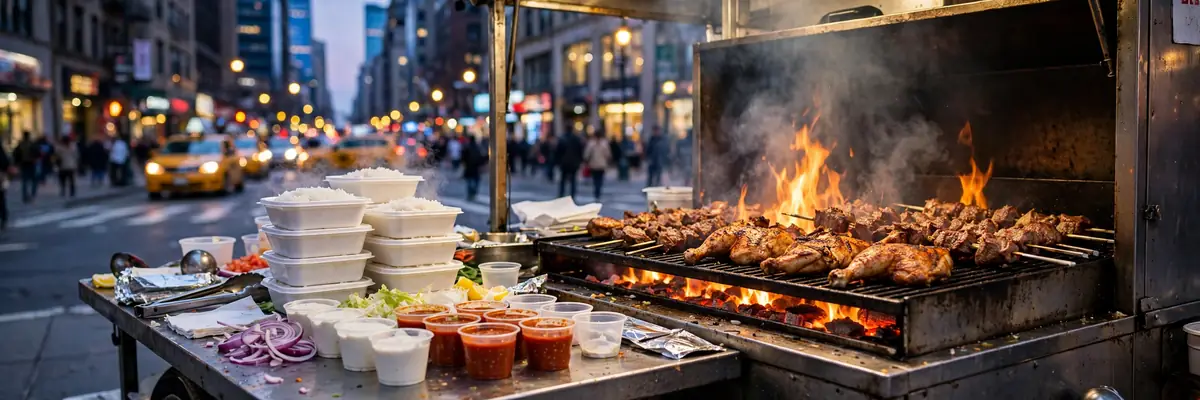
If you have never eaten from one of the best halal carts in NYC, you are missing one of America’s greatest food experiences. These stainless-steel street kitchens feed New Yorkers around the clock, serving mountainous platters of seasoned chicken and lamb over fragrant yellow rice, all drenched in the famous white sauce. What started in the early 1990s as a handful of carts feeding Muslim taxi drivers has grown into a citywide institution that locals defend with the same passion usually reserved for New York pizza or bagels.
The formula sounds simple: marinated meat shaved off a grill, tossed with rice and salad in a foam container, finished with white sauce and a drizzle of red hot sauce. However, the execution varies wildly from cart to cart. The great ones build lines that snake down the block, with cab drivers, office workers, and tourists all waiting together. After eating my way through dozens of carts across all five boroughs, I can tell you exactly where the magic happens, what to order, and how to avoid the impostors.
Why Halal Carts Became a New York Icon
To understand the halal cart phenomenon, you need to know its origin story. In 1990, a few Egyptian immigrants set up a hot-dog-style cart at the corner of 53rd Street and 6th Avenue in Midtown Manhattan. They served chicken and gyro over rice to a clientele of fellow Muslim immigrants, especially taxi and cab drivers who needed affordable, permissible food during long shifts. The word halal simply means the meat was prepared according to Islamic dietary law, which gave the carts their name.
The food itself was the hook that crossed every cultural boundary. The combination of turmeric-seasoned yellow rice, well-spiced grilled meats, crisp iceberg lettuce, diced tomato, and that creamy white sauce created a flavor profile unlike anything else on the street. Word spread fast. By the 2000s, halal carts had colonized corners across Manhattan, and the 53rd and 6th original became a genuine tourist destination with its own lore, its own devoted fans, and long lines at 2 a.m.
Today, the city has hundreds of halal carts, though quality varies enormously. The best carts share a few traits: fresh meat cooked to order rather than sitting in a steam tray, rice that is fragrant rather than mushy, and white sauce that tastes of mayonnaise, yogurt, and lemon rather than pure chemicals. The mediocre ones will still satisfy a hungry late-night crowd, but the great ones are worth traveling across the boroughs for.
Midtown Manhattan: Home of the Best Halal Carts in NYC
The 53rd and 6th Avenue Original
No list of halal carts in NYC can start anywhere else. The cart that started it all still operates at the corner of 53rd Street and 6th Avenue in Midtown, and it still draws the biggest crowds. Order the combo platter: chicken and lamb over rice with salad, extra white sauce, and a modest drizzle of the red hot sauce. The chicken here is famously juicy, marinated in a blend of warm spices before it ever hits the grill, and the lamb has a smoky depth that imitators rarely match.
A few practical tips: go slightly before or after the peak lunch rush if you can, bring cash even though most carts take cards now, and do not be shy about asking for the sauce on the side if you are new. The hot red sauce is genuinely hot, not a marketing gimmick, so build up gradually. For context on how New York’s late-night food scene evolved beyond the carts, our guide to America’s best food trucks covers ordering like a regular.
The Cart That Crosses All Boundaries
Just a few blocks away, another famous cart set up by a former employee of the original became its own empire, eventually expanding into brick-and-mortar locations nationwide. Purists still argue about which is better, which tells you both are excellent. This is a useful lesson about New York street food generally: competition on the same block raises everyone’s game. The same dynamic plays out with New York pizza, where rival slice shops keep standards high.
What sets the great Midtown carts apart is consistency under pressure. These vendors serve hundreds of platters per hour during the lunch rush, yet the best ones never let a dry batch of rice or overcooked chicken reach a customer. Watch the line: if locals in work boots and lanyards are waiting twenty minutes, you have found the right cart.
Best Halal Carts in NYC Beyond Manhattan: Brooklyn and Queens
Bay Ridge and the Yemeni Influence
Brooklyn’s halal cart scene deserves its own food tour. Bay Ridge, with its large Middle Eastern community, hosts carts where the spice blends lean Yemeni and Egyptian, with more cumin, more heat, and rice that sometimes carries hints of saffron. These carts tend to serve bigger portions at slightly lower prices than Manhattan, which is exactly why neighborhood regulars swear they are better.
The Brooklyn carts also innovate. Some offer falafel platters that rival the dedicated city’s best brunch spots, others add kofta kebabs or fish to the lineup. If you want to keep exploring sit-down options, our guide to the best Italian restaurants in New York City covers the red-sauce classics. If you are exploring Brooklyn’s food scene more broadly, pair your cart crawl with our roundup of food trucks worth chasing across the country, several of which were born in Brooklyn’s street-food boom.
Astoria’s Late-Night Corridors
Queens keeps New York’s street food honest. Astoria’s halal carts serve one of the most diverse crowds in the city, and the vendors know their audience: big portions, bold seasoning, and hours that stretch past midnight. The carts along Steinway Street and near the N and W subway stops are particularly strong, with several operated by families who have worked the same corner for decades.
What I love about the Queens carts is the customization culture. Regulars have standing orders, and vendors remember them. Ask for your chicken “extra crispy,” your salad heavy on the tomato, or your rice lightly sauced, and the cart will make it happen. Street food here covers every cuisine imaginable, from kebabs to tacos — see our guide to the best tacos in NYC for another street-food obsession. This kind of personal service is part of why street food here feels warmer and more human than most fast food, a theme that runs through our guide to America’s must-try burger joints.
What to Order: The Definitive Halal Cart Playbook
The Combo Platter Is King
If it is your first time, order the combo platter with chicken and lamb over rice. This is the canonical halal cart order, the one against which every cart is judged. The combo gives you both proteins, the full rice experience, and the salad that cuts through the richness. Most carts charge roughly eight to twelve dollars for a full platter, making it one of the best value meals in Manhattan.
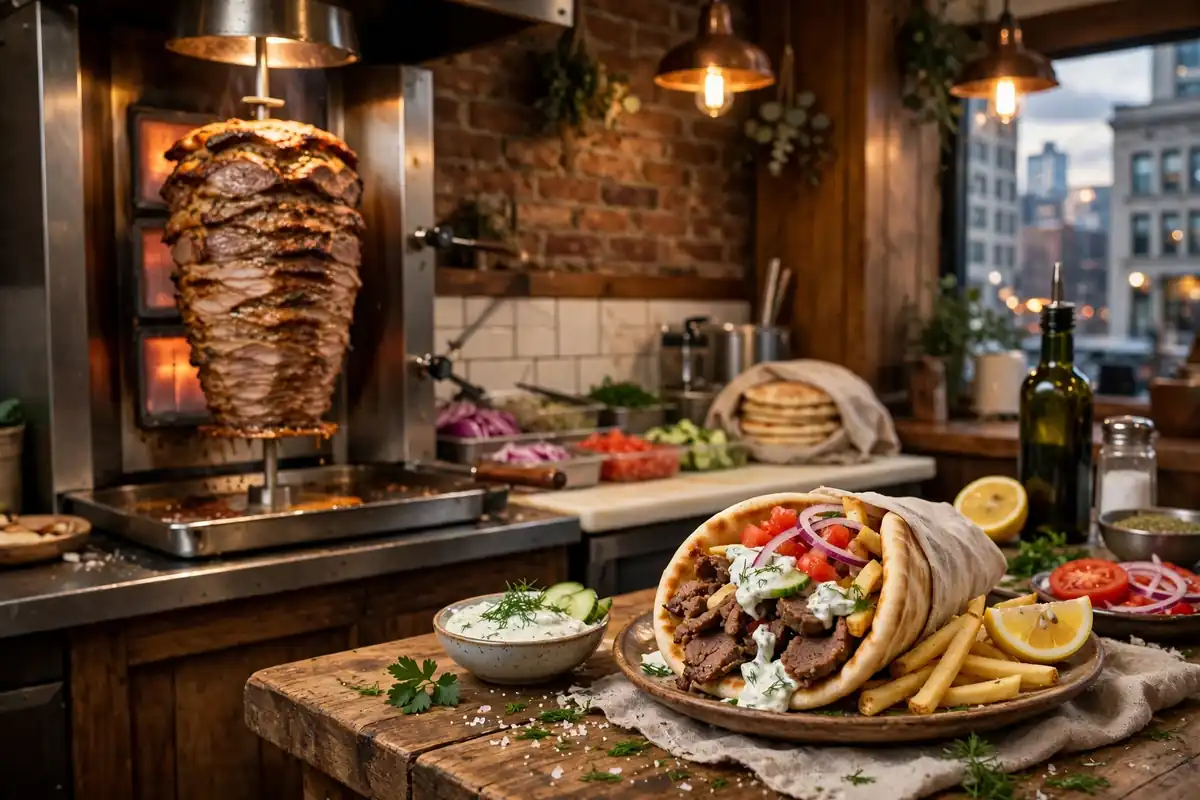
The gyro option, made from the same pressed lamb-and-beef cone you see at Greek restaurants, is the second-best choice and a direct link to the cart’s Middle Eastern roots. Some carts also do a fish platter, usually tilapia, which is underrated. Whatever you choose, the rice is half the dish: it should be yellow from turmeric, separate-grained rather than clumpy, and fragrant enough that you can smell it before the container opens.
White Sauce, Red Sauce, and How to Handle Them
The white sauce is the soul of the halal cart platter. Great white sauce tastes like a lemony garlic aioli with yogurt tang; it should be creamy, bright, and applied generously. The red sauce is a different animal entirely, a chili-based hot sauce that the cart legends wield with theatrical flair. My advice: get both, but ask the vendor to go light on the red until you know your tolerance. Many visitors make a full day of Midtown eating, pairing a cart platter at lunch with dinner at one of the classic steakhouses in New York City.
A pro move is requesting the sauces on the side in separate containers. This lets you dose each bite and, more importantly, preserves leftovers. A halal cart platter reheats remarkably well the next day, and having extra sauce on hand makes it even better. For another city where the topping debate never ends, see our guide to Philadelphia’s cheesesteak pilgrimage.
Halal Cart Etiquette and Insider Tips
Timing, Payment, and the Line
The best carts run on street rhythm, not posted hours. Midtown carts are strongest at lunch, when turnover is highest and everything is fresh. Late-night carts near nightlife areas hit their stride after midnight, serving a different crowd with the same quality. A cart with no line at peak hours is a red flag; a cart with a long line of locals is a green light.
Most carts now accept cards, but cash is faster and appreciated. Have your order ready before you reach the window, step aside to add sauces at the condiment area, and take your napkins before you walk away. These small courtesies keep the line moving and earn you the vendor’s respect, which often translates into extra meat on your next visit. The same unwritten rules apply at legendary Chicago’s Italian beef tradition, where ordering efficiently is practically a civic duty.
How to Spot a Great Cart
Look for these signs before you commit: meat grilling to order on a visible flat-top, rice in a covered tray rather than an open steam pan, a clean cart with organized condiments, and a menu that is short and focused. Carts that do five things well beat carts that do fifteen things adequately. Also trust your nose. The smell of spiced meat and turmeric rice drifting down the block is the best advertisement in New York.
One more test: watch what the vendor does with the chicken. Great carts chop fresh pieces off the grill for each order and toss them back on the heat for a final sear. Carts to avoid let pre-cooked meat sit in a warming tray for hours. If you want to compare street-food styles across cities, our guide to America’s best food trucks shows how the cart format inspired a nationwide movement.
The White Sauce Debate and Cart Rivalries
Ask two New Yorkers which cart is best and you will get three opinions. The rivalries are real and mostly friendly: the original versus the spin-off on nearby blocks, the Manhattan loyalists versus the Brooklyn converts, the white-sauce purists versus the everything-sauce maximalists. These debates are part of the culture, the same way pizza fans argue about best pizza in New York without ever reaching consensus.
My take after years of tasting: the differences between the top five carts are smaller than the differences between the top five and everyone else. Find the great cart nearest your routine, become a regular, and defend it passionately. That is the true New York way. And when friends visit from out of town, skip the overpriced Times Square restaurants and take them straight to a cart. They will remember that platter long after they forget the tourist traps.
Conclusion
The best halal carts in NYC prove that the greatest food in America does not always come from white-tablecloth dining rooms Sometimes it comes from a stainless-steel box on a street corner, served by people who have perfected one dish over decades. Whether you are a first-timer ordering the classic combo or a regular with a standing order and a sauce preference the vendor knows by heart, the halal cart is New York at its most generous: abundant, affordable, and open to everyone. Go hungry, bring cash, and do not skip the white sauce.