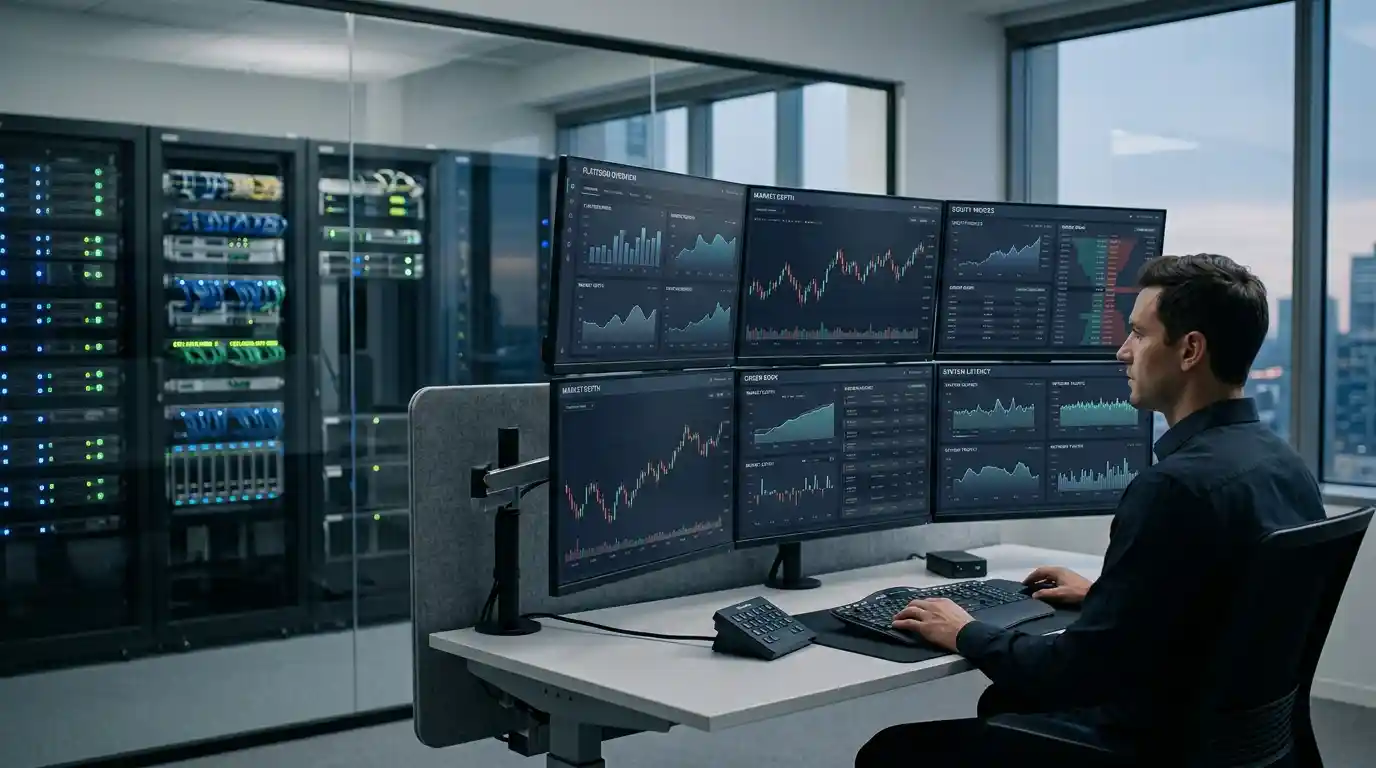
Consistent trading execution depends on more than market analysis, strategy design, or access to financial instruments. It also depends on whether the technology supporting each trade remains available, responsive, and dependable when market conditions change. For institutional trading desks and individual retail traders alike, platform uptime is a fundamental part of operational reliability.
Understanding the relationship between platform availability, execution quality, and risk management allows trading firms and individual participants to evaluate their technology more effectively.
What Platform Uptime Means in Trading
Platform uptime refers to the proportion of time a trading service remains available and operational. It can include access to the trading interface, order management services, market data, account information, and the infrastructure connecting traders with brokers or execution venues.
However, availability is not the same as execution quality. A platform might remain online while price updates become delayed, orders take longer to process, or confirmation messages arrive inconsistently. A meaningful assessment must therefore consider both service availability and the performance of critical trading functions.
For businesses evaluating digital infrastructure, the broader principles discussed in IT excellence and technology-driven business operations illustrate why reliable systems must support the outcomes users actually depend on, rather than simply appear operational.
Why Uptime Matters for Institutional Trading
Institutional trading environments can involve large order volumes, multiple execution venues, automated trading systems, liquidity connections, and strict operational controls. These activities depend on coordinated infrastructure that can process orders predictably under changing conditions.
Managing High Order Volumes
Institutional desks may process numerous orders within short periods, particularly when automated strategies respond to market movements. An interruption can delay order submission, interfere with position adjustments, or leave traders without timely visibility into outstanding orders.
Reliable infrastructure should be designed and tested for expected peak demand, not merely average activity. Capacity planning, redundant components, controlled deployments, and recovery procedures help reduce the likelihood that a single technical failure will interrupt essential functions.
Supporting Automated Execution
Algorithmic trading systems depend on continuous access to market data, order-routing services, and risk controls. If one component becomes unavailable, a strategy may miss an entry, fail to adjust an existing position, or continue operating without the information it needs.
Trading firms should define how automated strategies behave when connectivity fails. Depending on the strategy and its risk profile, appropriate safeguards may include suspending new orders, preserving the status of existing orders, triggering alerts, or switching to a verified backup environment.
Maintaining Operational Oversight
Institutional trading requires more than order processing. Teams also need reliable access to exposure information, execution records, account states, and operational alerts. When those functions are disrupted, staff may find it harder to assess risk and coordinate an appropriate response.
Clear incident procedures and dependable monitoring help trading teams understand which services remain available, what has failed, and which actions are safe to take during recovery.
Why Retail Traders Also Depend on Platform Reliability
Retail traders may operate smaller accounts, but the consequences of an interruption can still be significant. An individual managing a short-term position needs access to current prices, order controls, and account information just as an institutional desk needs access to its execution systems.
Reducing Missed Trading Opportunities
A temporary outage can prevent a trader from opening a planned position or responding to a price movement. The opportunity may disappear before access returns. That does not mean every missed trade would have been profitable, but it can prevent the trader from implementing the intended strategy.
Managing Open Positions
Platform interruptions are particularly concerning when a trader needs to adjust an existing position. If the interface becomes unavailable, the trader may be unable to submit a discretionary exit or modify an order through the usual workflow.
Before trading, users should understand their broker’s alternative order-submission procedures, available support channels, and the limitations of protective orders during outages, gaps, and volatile conditions. Stop-loss orders can help manage risk, but their execution price is not guaranteed in every market environment.
Supporting Trading Discipline
Reliable access helps traders follow their planned entry, exit, and risk-management processes. Repeated technical disruptions can encourage rushed decisions, unnecessary order resubmissions, or attempts to recover from missed opportunities.
Technology cannot eliminate emotional decision-making or guarantee profitable results. It can, however, reduce avoidable operational friction and make it easier to apply a consistent process.
How Downtime Can Affect Execution Quality
The practical impact of downtime depends on the instrument, order type, market conditions, and the stage of the trading process at which the failure occurs.
- Missed orders: An order may not reach the broker or execution venue while a service is unavailable.
- Delayed execution: A request may be processed later than intended if a system experiences congestion or partial degradation.
- Price slippage: The available market price may change between the order request and execution.
- Uncertain order status: A lost confirmation does not necessarily mean an order failed. Resubmitting without checking its status can create unintended duplicate exposure.
- Reduced risk visibility: Delayed account information may make it harder to assess open positions and available margin.
These outcomes are related but distinct. Uptime measures availability, latency measures delay, and slippage measures the difference between a reference price and the actual execution price. Tracking these separately helps identify whether a problem originates in platform availability, network performance, liquidity conditions, or order handling.
For firms examining wider operational performance, retail operational optimization offers a related perspective on the importance of reliable processes, coordinated systems, and performance measurement.
Uptime, Latency, and Execution Speed
High uptime does not automatically mean fast execution. A service can be available throughout a trading session while still responding too slowly for a particular strategy.
Latency can arise at several points: the trader’s device, the local network, the broker’s infrastructure, risk checks, order-routing systems, liquidity providers, or the exchange itself. The combined delay influences how quickly an order travels through the execution process.
Traders should assess typical and worst-case response times, particularly during busy sessions and major market announcements. Average latency alone can hide occasional delays that materially affect time-sensitive strategies. Percentile measurements, such as the 95th and 99th percentiles, provide a clearer picture of performance under less favorable conditions.
Institutional firms may require specialized connectivity and carefully positioned infrastructure, while many retail strategies can function adequately without ultra-low-latency systems. The appropriate performance target depends on the strategy, instrument, order frequency, and execution model.
Key Infrastructure Practices That Improve Reliability
1. Build Redundancy Into Critical Services
Redundancy reduces dependence on a single server, network connection, or infrastructure component. Depending on the architecture, backup systems can help maintain essential services when a primary component fails.
Backup arrangements must be tested. An inactive secondary server or an unverified failover process may provide little protection during a real incident. Teams should also understand how the system prevents conflicting processes from submitting duplicate orders during a transition.
2. Monitor Services Continuously
Effective monitoring should examine more than whether a website or application responds to a basic health check. It should also measure market-data freshness, order acknowledgements, execution delays, rejected orders, connection stability, and the availability of risk-management functions.
Alerts should identify meaningful changes before they become prolonged service disruptions. Clear escalation rules help technical teams distinguish a temporary fluctuation from an incident that requires immediate intervention.
3. Test Performance Under Heavy Load
Trading systems should be evaluated against realistic periods of elevated demand. Load testing and controlled failure simulations can reveal bottlenecks, overloaded queues, recovery problems, and dependencies that are not obvious during quiet market conditions.
Testing should include the complete order lifecycle where possible, from order submission through risk validation and routing to execution confirmation. A system that performs well in isolated component tests may still encounter problems when multiple services operate together.
4. Establish Recovery and Communication Procedures
Technical teams need documented recovery steps, clear incident ownership, and reliable communication channels. Traders also need understandable status updates that distinguish between a platform outage, delayed market data, and an issue affecting a specific order type.
Recovery procedures should include checks for outstanding orders, account reconciliation, and duplicate-order prevention. Restoring the login screen is not sufficient if underlying order states remain uncertain.
These operational principles are closely connected to broader business service development and operational resilience, where dependable systems support continuity and customer confidence.
How to Evaluate a Trading Platform’s Reliability
Traders and brokerage decision-makers can use a structured checklist instead of relying solely on promotional uptime claims.
- Review availability reporting. Ask how uptime is measured, which services are included, and whether scheduled maintenance is excluded.
- Examine execution metrics. Where available, review order acknowledgement times, execution latency, rejection rates, and slippage under different market conditions.
- Understand outage procedures. Confirm how to check open orders and positions when the usual interface is unavailable.
- Assess backup arrangements. Determine whether critical services have redundant infrastructure and tested recovery procedures.
- Check market-data reliability. Understand how stale prices, disconnected feeds, and delayed updates are identified and communicated.
- Evaluate security and access controls. Reliable service should be supported by appropriate authentication, controlled access, and incident-response procedures.
- Review support availability. Establish how urgent trading or account issues can be reported and escalated.
Availability commitments should be interpreted carefully. A stated service-level target describes a defined measurement and contractual commitment; it does not necessarily guarantee that every trading function will operate at full performance throughout every market event.
For technology-focused organizations, modern business technology solutions and technology-led business transformation are relevant broader areas of consideration when assessing how digital systems support service continuity.
Measuring Uptime With Meaningful Metrics
Uptime is commonly expressed as a percentage of the time a service remains available during a defined measurement period. For example, a 99.9% availability target permits approximately 8 hours and 46 minutes of unavailability over a 365-day period if measured continuously and without exclusions. The actual calculation depends on the provider’s measurement rules.
That figure alone does not show when interruptions occur. Several short disruptions during highly active trading sessions may be more operationally disruptive than a longer maintenance window scheduled outside the relevant market hours.
A more useful reliability dashboard combines availability with:
- Number and duration of unplanned incidents.
- Time required to detect and recover from failures.
- Order acknowledgement and execution latency distributions.
- Market-data interruptions and stale-price events.
- Order rejection rates and unexplained processing failures.
- Performance during peak order volume and volatile sessions.
Organizations can also define service-level objectives for critical functions. These targets should reflect the needs of the trading operation rather than use an arbitrary percentage without considering business impact.
The Role of Digital Transformation in Trading Reliability
Modern trading environments increasingly depend on cloud infrastructure, automation, real-time monitoring, and integrated data services. These technologies can improve visibility and recovery, but they also introduce dependencies that must be managed carefully.
Cloud hosting does not automatically eliminate downtime. Reliability still depends on architecture, configuration, network connectivity, access management, deployment practices, and the ability to recover from component failures.
Organizations planning technology improvements can benefit from the wider concepts covered in digital transformation in financial services, digital strategy for business firms, and scaling business operations across industries. The connection is operational: digital systems must be designed around measurable service outcomes and the needs of the people who rely on them.
Trading firms should also examine how monitoring, deployment controls, and recovery processes fit into their overall technology strategy. A well-managed environment combines prevention, detection, containment, and recovery rather than depending on any single tool or provider.
Practical Steps Retail Traders Can Take
Individual traders cannot control a broker’s entire infrastructure, but they can reduce some avoidable risks:
- Use a stable internet connection and keep account recovery details secure.
- Install platform updates before important trading periods rather than during active positions whenever practical.
- Understand the broker’s official procedures for submitting or checking orders during an outage.
- Keep appropriate records of order requests, confirmations, and support communications.
- Review whether any automated strategy depends on a local computer, remote server, or uninterrupted connection.
- Set position sizes and risk limits that account for the possibility of delayed access or unexpected market movements.
Traders using automated tools should ensure that the strategy handles connection loss and uncertain order status safely. Running an algorithm on a continuously available server can reduce dependence on a home computer, but it does not guarantee that the broker, data feed, network, or execution venue will remain available.
Common Misconceptions About Platform Uptime
High Uptime Guarantees Profitable Trading
It does not. Reliable access helps traders implement a strategy, but profitability depends on many other factors, including strategy quality, costs, risk controls, market conditions, and execution outcomes.
A Platform Is Reliable Whenever the Website Loads
A responsive login page does not prove that market data, order routing, account updates, and confirmations are functioning correctly. Critical services should be evaluated individually and as part of the complete trading workflow.
Every Delay Is Caused by the Trading Platform
Delays may originate in the trader’s connection, a broker’s infrastructure, an execution venue, liquidity conditions, or other components. Diagnosis requires evidence from the relevant stages of the process rather than assuming a single cause.
Backup Systems Eliminate Every Failure
Redundancy reduces certain single points of failure, but backup systems can share dependencies or encounter problems of their own. Regular testing, clear failover rules, and post-incident reviews remain essential.
Conclusion
Platform uptime is a core requirement for consistent trading execution in both institutional and retail environments. Reliable infrastructure helps traders access market information, manage orders, monitor exposure, and follow established processes without unnecessary technical interruptions.
However, uptime should never be evaluated in isolation. Execution latency, market-data quality, order handling, recovery procedures, and performance under heavy demand provide a more complete picture of operational reliability.
For institutions, the priority is to build and test resilient systems that support high-volume activity, automation, and effective oversight. For retail traders, it is to understand platform limitations, prepare for interruptions, and use appropriate risk controls.
Ultimately, dependable technology cannot remove market risk or guarantee returns. It can provide a stronger operational foundation for making and executing trading decisions consistently.
Connecting Platform Reliability With Broader Business Performance
Technology reliability also matters beyond the trading interface. Organizations that depend on connected systems need to understand how service availability affects operational continuity, user experience, and performance measurement. The article on technology supporting business operations explores this wider operational context.
Businesses can also benefit from examining technology systems and connected electronics, particularly when evaluating the importance of dependable data and infrastructure. Similarly, industrial technology and operational performance highlight the value of dependable systems in environments where interruptions can affect essential processes.
Performance measurement is another useful connection. The principles behind digital marketing return on investment and ROI analysis across industries illustrate why organizations need measurable outcomes rather than relying on headline metrics alone. In the same way, trading-platform evaluations should consider execution quality and recovery performance alongside reported uptime.
For organizations managing complex digital operations, digital performance measurement in Doha and the changing retail business environment provide further context for assessing how technology, service delivery, and operational decisions contribute to broader business objectives.