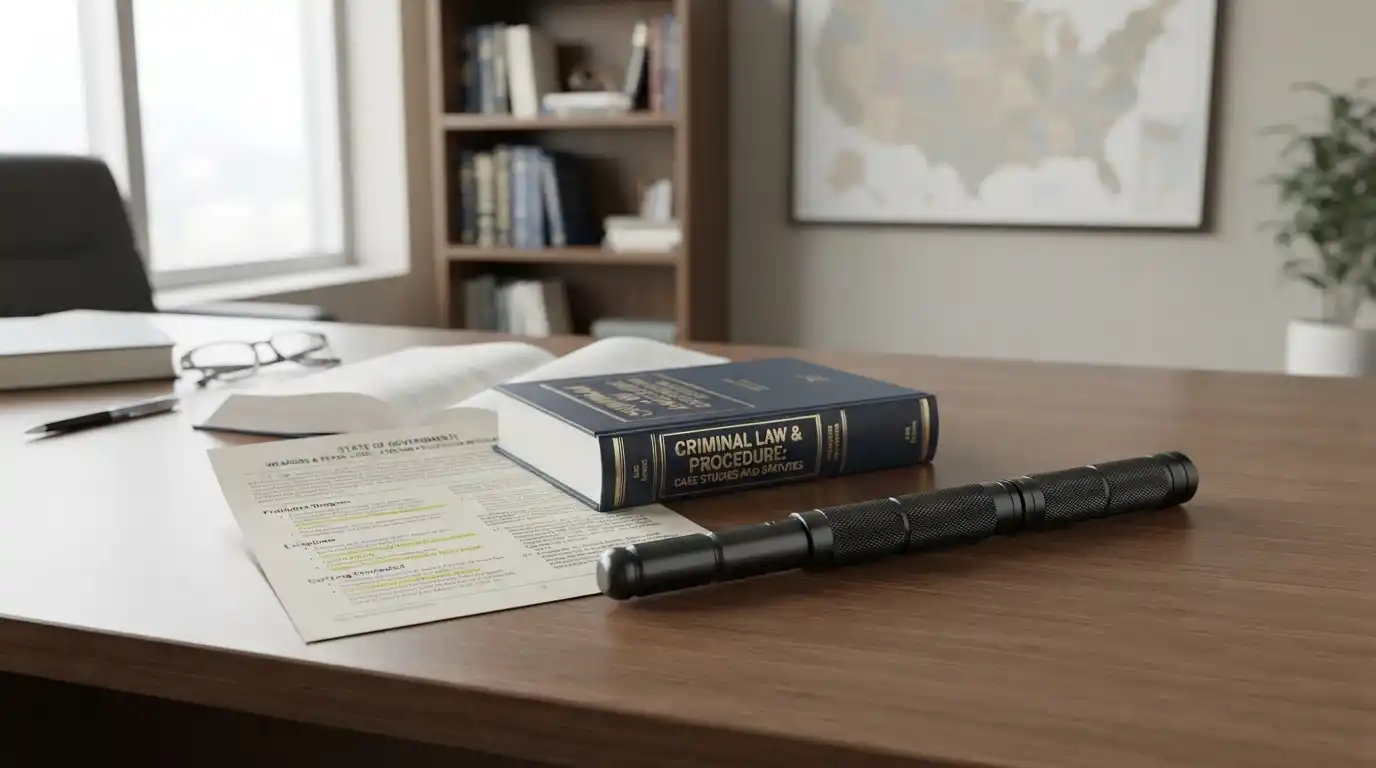
Expandable batons can fall under different weapon classifications depending on state law. Some jurisdictions allow civilian ownership but restrict public or concealed carry. Others prohibit certain types of batons altogether. Local rules and restricted locations can create additional complications.
This guide explains the most important issues to understand before buying, possessing, carrying, or using a collapsible baton in the United States. Because laws can change and individual circumstances matter, treat this article as general educational information rather than individualized legal advice.
Are Collapsible Batons Legal in the United States?
Collapsible batons are legal for civilian ownership in many parts of the United States, but that does not mean they can automatically be carried anywhere or in any manner.
The biggest mistake people make is treating ownership, possession, carrying, and use as if they were the same legal question. They are not.
A state may allow you to purchase and keep an expandable baton at home while imposing restrictions on carrying it in public. Another state may regulate concealed carry differently from open carry. Some jurisdictions may classify a baton as a prohibited weapon regardless of whether you intend to use it for protection.
That is why checking the law for your specific state and, when applicable, your city or county is important before carrying one.
Ownership Is Not the Same as Carrying
One of the most important distinctions in baton laws is the difference between possessing a baton and carrying a baton in public.
For example, a person may be permitted to purchase a collapsible baton and store it at home but face restrictions when taking it outside. Concealing it inside clothing, a bag, vehicle compartment, or another location may also trigger different rules depending on the jurisdiction.
Before carrying a baton, consider these separate questions:
- Is civilian possession legal in your state?
- Is public carry permitted?
- Is concealed carry restricted?
- Does your state require a permit or license?
- Are there age restrictions?
- Are there restrictions on specific baton designs?
- Are there local ordinances that add additional limitations?
- Are certain locations completely off-limits?
Answering all of these questions is more useful than simply asking whether a baton is “legal.”
Why State Laws Matter So Much
Weapon laws in the United States are largely a combination of federal, state, and local rules. A collapsible baton that is lawful in one state may be treated very differently somewhere else.
Some states have statutes that specifically identify clubs, billy clubs, blackjacks, or similar impact weapons. In other states, the legal analysis may depend on how the item is classified and how it is carried.
This means online lists claiming that collapsible batons are simply “legal in every state except a few” should be treated cautiously. The actual rules can involve distinctions between possession, open carry, concealed carry, intent, location, and the particular design of the weapon.
States With Stricter Baton Restrictions
Several jurisdictions have historically taken a particularly restrictive approach to batons and similar impact weapons. California and New York, for example, have had significant legal restrictions involving weapons commonly described as billy clubs or similar instruments.
However, state weapon laws can change through legislation, court decisions, injunctions, and enforcement policies. A rule that was accurate several years ago may not accurately describe the current legal situation.
This is especially important for California because litigation surrounding baton restrictions has affected how the relevant law is interpreted and enforced. Anyone considering carrying a collapsible baton there should check the current legal position rather than relying on an old state-by-state chart.
New York also deserves particular attention because courts have considered whether a collapsible metal baton can fall within statutory language covering a “billy.” The fact that a baton collapses does not automatically prevent it from being classified as a prohibited weapon.
Open Carry vs. Concealed Carry
Another major issue is whether a baton is carried openly or concealed.
Some jurisdictions distinguish between these two methods. A state may permit one while restricting or prohibiting the other. In jurisdictions where concealed weapons laws apply to impact weapons, putting a baton inside clothing or otherwise hiding it from ordinary view may create a separate legal problem.
Do not assume that a baton is legal simply because it is small enough to fit inside a pocket or bag. Its compact design can actually be one of the factors that makes concealed carry legally significant.
If you are considering carrying one, determine exactly how your jurisdiction defines concealed carry and whether the applicable law covers clubs, batons, dangerous weapons, or similar instruments.
Can You Carry a Collapsible Baton for Self-Defense?
People often search for collapsible batons because they want a non-firearm option for personal protection. However, the fact that an item is intended for self-defense does not automatically make possession or carry lawful.
Self-defense laws generally focus on the circumstances in which force is used. They do not necessarily create a blanket exception allowing someone to carry a prohibited weapon.
There is also an important difference between possessing an object for protection and using force against another person. Even where possession is lawful, using a baton during a confrontation can create serious criminal and civil consequences if the force is considered unreasonable.
In a genuine emergency, the legal analysis may depend on factors such as the immediacy of the threat, the level of force involved, whether the person could safely disengage, and the circumstances surrounding the encounter.
When Using a Baton Can Create Legal Problems
Even when possession and carry are lawful, misuse can lead to serious consequences.
A collapsible baton is an impact weapon capable of causing substantial injury. Striking another person can result in allegations involving assault, battery, aggravated assault, or other offenses depending on the circumstances and jurisdiction.
Using one during an argument, threatening someone with it, displaying it to intimidate another person, or carrying it with unlawful intent can make an otherwise lawful object part of a criminal case.
The safest legal principle is simple: do not treat legality of possession as permission to use force whenever you feel threatened or angry.
Restricted Places Can Change the Answer
Even if your state allows civilian possession or carry, certain locations may prohibit weapons.
These restrictions can apply to places such as:
- Courthouses and court facilities
- Schools and educational facilities
- Government buildings
- Secure transportation facilities
- Airports and screening areas
- Correctional facilities
- Private businesses that prohibit weapons
- Other locations specifically regulated by state or local law
Transportation rules can also be different from ordinary public-carry rules. For example, an item that may be lawful to possess at home does not automatically become acceptable in carry-on luggage or at a security checkpoint.
Always check the rules that apply to the specific location you intend to enter.
Can You Keep a Collapsible Baton in Your Car?
Keeping a collapsible baton inside a vehicle can create another layer of legal complexity.
Some jurisdictions distinguish between carrying a weapon on your person and transporting one inside a vehicle. Other laws may focus on whether the weapon is concealed, readily accessible, or stored in a particular manner.
Because vehicle-storage rules vary, do not assume that putting a baton inside a glove compartment, center console, door pocket, or backpack makes it legal.
If your state permits possession but restricts concealed carry, the way a baton is transported may be especially important.
What About Private Property?
Private-property rules can differ from public-carry rules.
Keeping a lawful baton inside your own residence is often treated differently from carrying it on a public street. However, property owners, employers, schools, apartment complexes, and businesses may impose their own restrictions.
A workplace can prohibit weapons even when state law does not completely prohibit them. Similarly, a private business may ask customers to leave if they violate its weapons policy.
Therefore, “legal in my state” does not necessarily mean “allowed everywhere I go.”
Why the Type of Baton Matters
The word baton can describe several different objects. A traditional fixed baton, an expandable metal baton, a weighted weapon, and other impact tools may not receive identical legal treatment.
Design can matter because statutes sometimes identify specific weapon categories rather than using one universal definition for every object that resembles a club.
If you are researching a particular baton, identify its exact type, construction, length, mechanism, and intended use before attempting to determine its legal status.
Common Mistakes People Make
1. Assuming Federal Law Controls Everything
People sometimes search for a single federal rule and assume that the answer will apply throughout the country. Baton regulations are much more complicated because state and local law can determine whether civilian possession or carry is permitted.
2. Trusting an Old State-by-State Chart
Weapon laws can change. Court decisions can also affect how statutes are interpreted. An article or chart published several years ago may no longer provide a reliable answer.
3. Confusing Ownership With Public Carry
Being allowed to purchase an item does not necessarily mean you can carry it concealed or openly in every public location.
4. Assuming Self-Defense Makes Everything Legal
A self-defense purpose does not automatically override weapon-possession restrictions. It is important to separate the legality of the weapon from the legal rules governing the use of force.
5. Ignoring Local Rules
State law may not be the only consideration. Depending on the jurisdiction, local regulations and location-specific restrictions may also matter.
How to Check Whether a Collapsible Baton Is Legal
If you want the most reliable answer for your situation, use a methodical approach rather than relying on a general internet list.
- Identify your state. Start with the laws where you live or where you plan to carry the baton.
- Identify the exact weapon. Determine whether it is an expandable baton, fixed baton, club, or another type of impact weapon.
- Check possession rules. Determine whether civilian ownership is permitted.
- Check carry rules. Look separately at open and concealed carry.
- Check location restrictions. Find out whether schools, government buildings, courts, transportation facilities, or private properties impose additional restrictions.
- Check vehicle rules. If you intend to transport the baton, determine whether special storage requirements apply.
- Check recent legal developments. Look for recent legislation and court decisions that may have changed the interpretation of the law.
- Ask a qualified attorney when necessary. If the consequences of getting the answer wrong are significant, professional legal advice is safer than relying on a general online article.
What Are the Potential Consequences of Illegal Possession?
The consequences depend entirely on the applicable jurisdiction and offense.
Depending on the law, unlawful possession or carrying of a prohibited weapon can result in a citation, misdemeanor charge, felony charge, fines, probation, confiscation of the weapon, or incarceration. Using the weapon against another person can expose someone to substantially more serious criminal liability.
There can also be civil consequences. If another person is injured, a person who used a baton may face a civil claim even when the criminal case does not result in a conviction.
That is why the legal question should be answered before carrying the weapon rather than after an encounter occurs.
Are Collapsible Batons a Good Self-Defense Option?
Legality is only one consideration. A collapsible baton also requires judgment, training, and an understanding of the consequences of using an impact weapon.
Someone carrying a baton without understanding applicable laws may unintentionally create legal exposure. An untrained person may also escalate a confrontation instead of safely leaving it.
For many people, avoidance, de-escalation, awareness, and leaving a dangerous situation are more important than having a physical weapon available.
If you are considering any defensive tool, understand the law first and make sure you know the rules governing its possession, carry, and use.
Final Answer: Are Collapsible Batons Legal?
So, are collapsible batons legal? In many parts of the United States, civilians can legally possess some types of collapsible batons, but the rules are not uniform nationwide.
The legality can depend on your state, local jurisdiction, the exact type of baton, whether it is openly or secretly carried, where you take it, and how you use it. Some jurisdictions have particularly restrictive laws, while others focus more heavily on the manner of carry or circumstances of use.
Before buying or carrying a collapsible baton, check the current law applicable to your location and the specific type of baton involved. If the legal consequences are important to you, consult a qualified attorney who can evaluate your particular circumstances.
Most importantly, do not assume that an old state-by-state chart, product listing, forum comment, or general statement about “self-defense weapons” accurately describes the law where you live today.