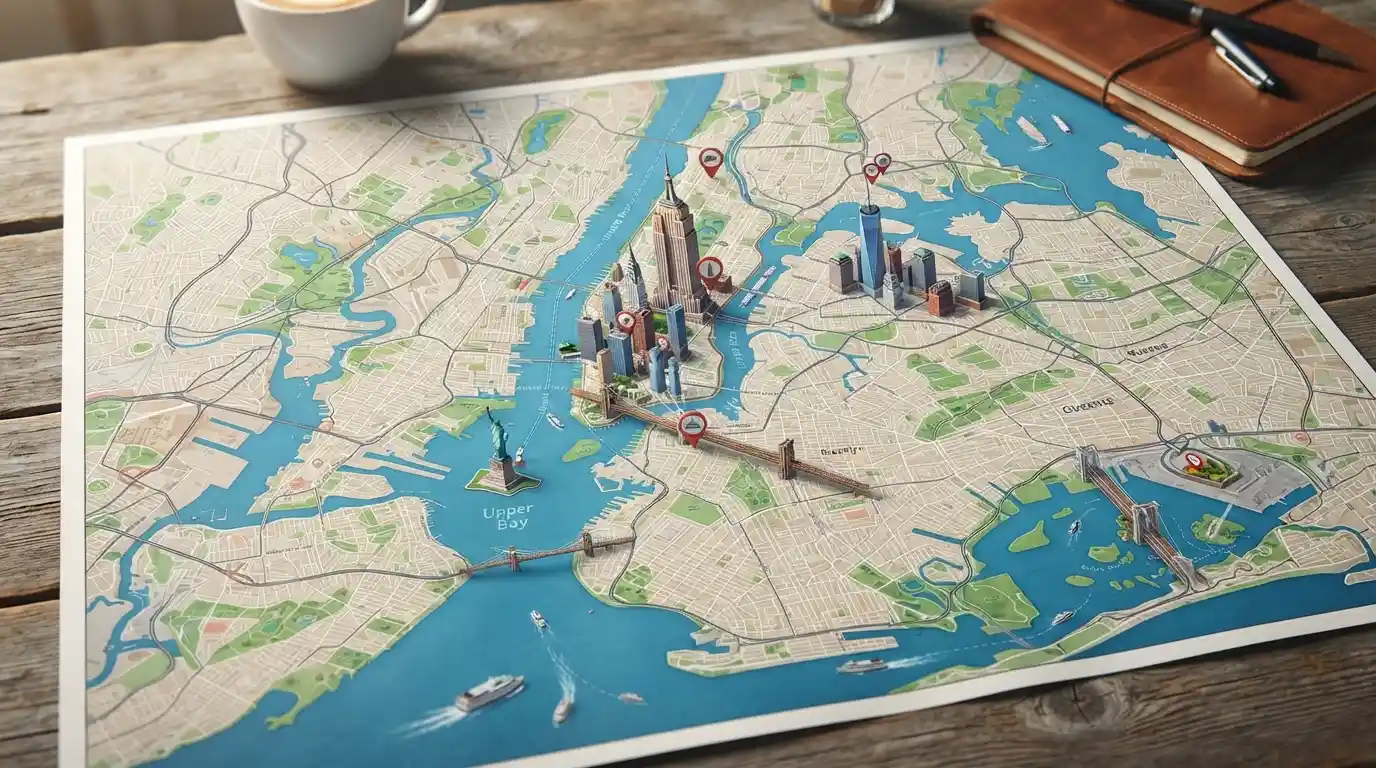
Whether you are visiting New York for the first time or returning to explore beyond the traditional tourist route, organizing attractions by region can help you build a more practical itinerary. Instead of crossing the city repeatedly, you can group nearby destinations together and spend more time exploring.
Understanding the Five Boroughs of New York
The most useful starting point for a New York travel map is understanding its five boroughs. Manhattan is generally the first stop for visitors because many internationally recognized attractions are concentrated there. Brooklyn offers a different atmosphere, with waterfront views, historic neighborhoods, parks, arts, and food. Queens is known for its cultural diversity, museums, parks, and neighborhood experiences. The Bronx combines sports, gardens, cultural attractions, and historic communities, while Staten Island provides waterfront scenery and a quieter alternative to some of the city’s busier districts.
Looking at the city borough by borough gives travelers a better sense of geographic distance. It also helps when choosing accommodation and planning transportation between attractions.
Manhattan: The Main Attraction Hub
For many first-time visitors, Manhattan forms the central section of a New York sightseeing map. The borough contains several major attractions within relatively compact areas, although walking between distant neighborhoods can still take considerable time.
Midtown Manhattan
Midtown is home to some of the city’s most recognizable landmarks. Times Square, Rockefeller Center, Bryant Park, Grand Central Terminal, Fifth Avenue, and the Empire State Building are all important points to identify when planning a Manhattan itinerary.
Travelers interested in museums and cultural attractions can also connect Midtown with nearby destinations. Broadway theaters make the area especially popular in the evening, while shopping streets provide plenty of options during the day.
Central Park and the Upper Side
Central Park creates a major green space in the middle of Manhattan and provides a useful reference point when reading a city map. Around the park are museums, residential neighborhoods, cultural institutions, and scenic walking routes.
The Upper East Side and Upper West Side can each be explored as separate sections of an itinerary. This approach makes it easier to combine Central Park with nearby museums rather than traveling back and forth across Manhattan.
Lower Manhattan
Lower Manhattan has a different character, with historic streets, waterfront areas, financial districts, memorials, and access to several important harbor destinations. The Financial District, Battery Park, South Street Seaport, and the Brooklyn Bridge are useful landmarks to identify on a New York map.
The area is also an excellent starting point for travelers interested in seeing the Statue of Liberty and the surrounding harbor. Nearby neighborhoods such as Chinatown, SoHo, and Greenwich Village can be added depending on how much time you have.
Brooklyn: Waterfront Views, Neighborhoods and Parks
Brooklyn sits across the East River from Manhattan and is one of the most useful areas to explore when building a broader New York itinerary. The borough combines waterfront destinations with historic neighborhoods, parks, cultural attractions, restaurants, and entertainment.
Brooklyn Heights and DUMBO are particularly useful locations to mark on a sightseeing map because of their relationship to the Brooklyn Bridge and Manhattan skyline. Walking routes through these areas can produce excellent city views without requiring a long trip across the borough.
Travelers looking for more open space can include Prospect Park and nearby cultural attractions. Those interested in beaches and amusement areas can continue toward Coney Island.
If your trip includes several destinations outside Manhattan, it can be useful to compare this area with other places to visit in New York and nearby regional travel ideas.
Queens: Culture, Food and Diverse Neighborhoods
Queens is New York City’s largest borough by area and offers a broad range of experiences. Instead of treating Queens as one single attraction zone, divide it into smaller areas based on your interests.
Long Island City is useful for travelers interested in skyline views, waterfront parks, and contemporary urban scenery. Astoria has a strong neighborhood identity and a diverse food scene, while Flushing is particularly interesting for visitors seeking international food and cultural experiences.
Queens also has attractions suited to families, museum visitors, sports fans, and travelers who want to experience a different side of New York. A detailed city map can help you determine which destinations can realistically be combined during the same day.
The Bronx: Parks, Culture and Sports
The Bronx occupies the northern section of New York City and deserves space on any map focused on attractions beyond Manhattan. One of the borough’s major attractions is the Bronx Zoo, while the New York Botanical Garden provides another major reason to visit.
Sports fans can also place Yankee Stadium on their itinerary. Other areas of the Bronx offer museums, historic locations, neighborhood dining, and cultural experiences.
Because the borough covers a substantial area, travelers should group attractions geographically instead of assuming that every destination is close together.
Staten Island: Waterfront Scenery and a Different Pace
Staten Island is the southernmost borough and provides a noticeably different pace from the busiest parts of Manhattan. It can be particularly appealing to travelers who want waterfront scenery, parks, museums, and residential neighborhoods.
Its position within New York Harbor also makes it useful for understanding the city’s wider geography. When looking at a map of New York, Staten Island helps show how the harbor connects the city’s five boroughs.
Important Regions to Mark on a New York Travel Map
Rather than marking hundreds of individual attractions, first identify the major sightseeing regions. This makes itinerary planning much easier.
- Midtown Manhattan: Times Square, Broadway, Rockefeller Center, Bryant Park, and nearby shopping.
- Central Manhattan: Central Park and major museums.
- Lower Manhattan: Financial District, Battery Park, waterfront attractions, and historic neighborhoods.
- Brooklyn waterfront: Brooklyn Heights, DUMBO, bridge viewpoints, and East River scenery.
- Western Queens: Long Island City, waterfront parks, museums, and skyline views.
- The Bronx: Yankee Stadium, botanical attractions, zoos, parks, and cultural destinations.
- Staten Island: Harbor views, parks, museums, and waterfront areas.
How to Use a New York Attractions Map
A map is most useful when it becomes part of your itinerary rather than simply a list of attractions. Start by identifying the destinations you consider essential. Then divide them into geographic groups.
For example, you could dedicate one day to Midtown and Central Park, another to Lower Manhattan and the waterfront, and another to Brooklyn. Additional days can be used for Queens, the Bronx, or Staten Island depending on your interests.
This approach reduces unnecessary travel and gives you more flexibility if a particular neighborhood turns out to be more interesting than expected.
Planning Around Different Travel Interests
New York works well for different types of travelers because its attractions are distributed across many regions. Families may want to prioritize parks, museums, zoos, and interactive attractions. Couples might prefer waterfront walks, neighborhoods, restaurants, and evening entertainment. Architecture enthusiasts can focus on historic districts and landmark buildings.
Travelers who enjoy seasonal trips can also use the wider collection of places to visit in September and October, while winter travelers can compare the city with other winter destinations when building a larger trip.
New York Attractions Beyond the Main Tourist Route
Once the major landmarks are mapped out, consider adding less obvious neighborhoods and experiences. This is where New York becomes much more interesting. Neighborhood restaurants, local parks, independent shops, cultural centers, historic streets, and waterfront walks can provide experiences that feel very different from the city’s most photographed locations.
Travelers who enjoy discovering unusual destinations can also explore our guide to strange places to visit around the world for inspiration beyond conventional sightseeing.
Combining New York With Other Destinations
If New York is part of a longer North American journey, the city’s location makes it possible to build a broader travel plan. Visitors can compare New York with other destinations in the United States, including Upstate New York, Michigan, Utah, and Germany if international travel is also part of the plan.
For travelers who want more U.S. sightseeing ideas, related guides covering Central Texas, San Leandro, Georgia’s Coastal Plain, and South Florida can help expand an itinerary.
Tips for Reading a New York Travel Map
- Start with the five boroughs: Understand where Manhattan, Brooklyn, Queens, the Bronx, and Staten Island are located.
- Group nearby attractions: Avoid building an itinerary that repeatedly crosses the city.
- Check transportation: Subway lines, buses, ferries, bridges, and walking routes all influence travel time.
- Allow extra time: A destination that looks close on a map may take longer to reach because of crowds, transfers, or walking routes.
- Balance famous and local attractions: Combine major landmarks with neighborhood experiences.
- Leave room for changes: A flexible itinerary works better than scheduling every minute.
Final Thoughts
A detailed map of places to visit in New York is more than a collection of pins. It helps travelers understand the relationship between the city’s boroughs, neighborhoods, attractions, parks, waterfronts, and cultural districts.
Manhattan may contain many of the city’s most famous landmarks, but Brooklyn, Queens, the Bronx, and Staten Island add important dimensions to the New York experience. By organizing attractions by region and planning days around geographic areas, visitors can create a smoother itinerary while discovering more of what the city has to offer.
For more travel planning inspiration, explore related guides covering New York attractions, New York travel planning, Philadelphia, New Jersey destinations, and Providence, Rhode Island.