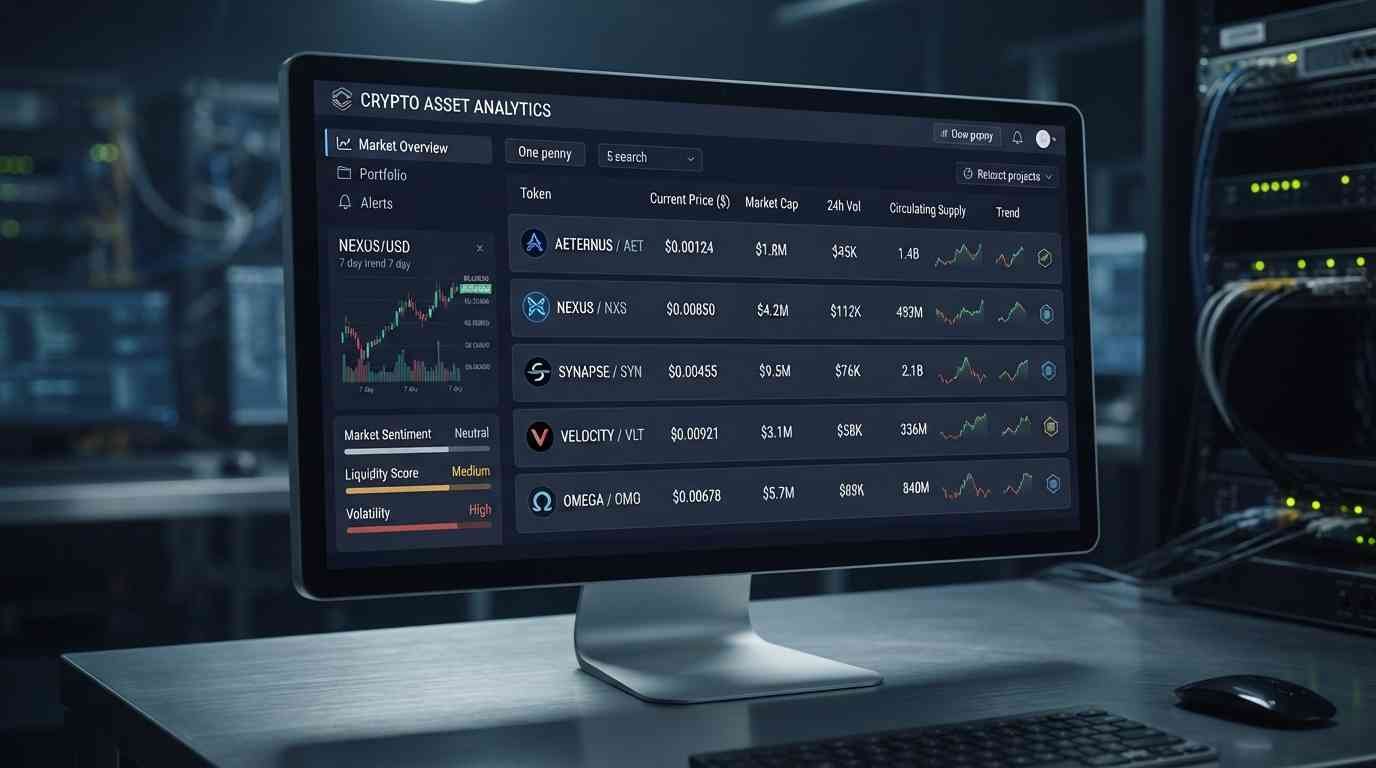
The more useful approach is to look beyond the sticker price. Market capitalization, circulating supply, tokenomics, liquidity, utility, development activity, adoption, and security can tell you much more about a digital asset than whether it trades at $0.009, $0.05, or $0.50.
This guide explains how to research cryptocurrencies under a penny, what makes them interesting, which warning signs deserve attention, and why a disciplined evaluation process matters.
What Does Cryptocurrency Under a Penny Mean?
A cryptocurrency under a penny is a digital asset whose current price is below $0.01 per token. These assets are sometimes described as penny cryptocurrencies, sub-cent cryptocurrencies, or low-priced crypto.
The important point is that the price of one token represents only one part of the overall valuation. A cryptocurrency can have a price below one cent while having billions or trillions of tokens in circulation.
For example, a token priced at $0.005 with 20 billion circulating tokens would have a circulating market capitalization of approximately $100 million. A different token priced at $5 with only 20 million circulating tokens would also have a $100 million market capitalization.
That is why comparing cryptocurrencies solely by their unit price can create a misleading picture.
Why Do Some Cryptocurrencies Trade Below One Penny?
Several factors can result in an extremely low token price. The most common is a large token supply. When a project has billions or trillions of units, the value of the network is divided across a very large number of tokens.
Other factors can include:
- Limited adoption or demand
- Early-stage project development
- Limited exchange availability
- Low trading liquidity
- Weak or unproven utility
- Large future token unlocks
- Speculative market sentiment
- Competition from established cryptocurrency projects
Some low-priced projects may also have legitimate technology or specific use cases. Others may depend heavily on speculation. The price itself does not tell you which category a project belongs to.
Cryptocurrency Under a Penny vs. Market Capitalization
Market capitalization is one of the first metrics to examine when researching a low-priced cryptocurrency. It is generally calculated by multiplying the current token price by the circulating supply.
Consider two hypothetical cryptocurrencies:
| Metric | Token A | Token B |
|---|---|---|
| Token price | $0.005 | $0.50 |
| Circulating supply | 20 billion | 200 million |
| Approximate market cap | $100 million | $100 million |
Although Token A appears dramatically cheaper on a per-unit basis, both hypothetical assets have the same market capitalization. This demonstrates why token price should not be treated as a standalone measure of value.
For broader financial context, readers can also explore Rexas Finance launch information and financial trends and market discussions.
Does a Sub-Cent Cryptocurrency Have Explosive Potential?
A low-priced cryptocurrency can experience a large percentage move if demand increases significantly. Moving from $0.001 to $0.002, for example, represents a 100% increase even though the absolute price difference is only a fraction of a cent.
However, percentage potential works in both directions. A token that falls from $0.002 to $0.001 also loses 50% of its value.
For this reason, phrases such as “explosive potential” should be treated as a description of possible price movement rather than a promise of future performance.
The CFTC advises cryptocurrency buyers to conduct extensive research and warns against promises or guarantees of future value.
What to Check Before Researching Cryptocurrency Under a Penny
1. Market Capitalization
Start by examining the project’s circulating market capitalization. A very low token price combined with an enormous supply can already represent a substantial valuation.
2. Circulating and Maximum Supply
Compare the number of tokens currently circulating with the total or maximum supply. A large gap can indicate potential future dilution if additional tokens enter circulation.
This makes tokenomics particularly important when comparing low-priced cryptocurrencies with different supply structures.
3. Real Utility
Ask what the cryptocurrency actually does. Does it support transactions, decentralized applications, payments, gaming, decentralized finance, infrastructure, or another identifiable use case?
A project with a clearly defined purpose can be easier to evaluate than one whose entire proposition depends on price speculation.
4. Development Activity
Look at whether the project is actively maintained and developed. Regular updates, technical documentation, software releases, and transparent development can provide useful context.
Technology-focused readers may also find related material such as modern technology solutions, technology-driven business operations, and technology and digital innovation useful for understanding the broader role technology can play in modern projects.
5. Liquidity and Trading Activity
Liquidity matters because an asset can be difficult to buy or sell efficiently when there are not enough active buyers and sellers.
A cryptocurrency may show a dramatic price increase on a small amount of trading activity, but that movement may not be sustainable. Thin liquidity can also make price declines more severe.
6. Token Distribution
Research who controls a significant portion of the token supply. Large holdings concentrated among a small number of wallets can create additional market risks.
7. Project Team and Transparency
Look for information about the development team, organization, documentation, roadmap, partnerships, and project communication. Missing or unverifiable information deserves additional scrutiny.
Why Token Supply Matters So Much
Supply is one of the biggest reasons that low-priced cryptocurrency can be misunderstood.
Imagine a project with one billion tokens and another with one trillion tokens. Even if both projects have the same overall valuation, the individual token prices can be dramatically different.
This is also why a cryptocurrency trading below one penny does not necessarily have more room to grow than a cryptocurrency trading at several dollars.
Readers interested in the relationship between supply and cryptocurrency valuation can also explore cryptocurrency limited supply and digital scarcity.
Low Price Does Not Mean Low Risk
One of the biggest misconceptions surrounding sub-cent cryptocurrencies is that a low price limits downside risk. In reality, the opposite can occur.
A cryptocurrency trading at $0.001 can fall to $0.0005, representing a 50% decline. It can also lose most of its value if liquidity disappears, the project fails, demand collapses, or confidence in the project deteriorates.
Crypto assets can also face security, fraud, technological, regulatory, and market risks. The CFTC specifically highlights factors such as liquidity, technological changes, adoption, competition, theft, and future demand when evaluating digital coins and tokens.
Cryptocurrency Under a Penny and Speculation
Low-priced cryptocurrencies often attract speculative interest because investors may focus on the number of tokens they can purchase rather than the value of the underlying project.
For example, buying 100,000 tokens can psychologically feel more significant than owning a smaller number of a higher-priced asset. But the number of tokens owned does not determine the percentage return.
Speculation can also be intensified by social media trends, viral campaigns, influencer attention, and rapidly changing market sentiment.
Projects connected to cryptocurrency marketing can be explored through cryptocurrency marketing strategies, while readers interested in digital payment applications can review Venmo and cryptocurrency.
Warning Signs to Watch For
Before considering any cryptocurrency under a penny, watch for warning signs that may indicate elevated risk.
- Unrealistic guaranteed-return claims
- Anonymous or unverifiable project leadership
- Little or no meaningful product development
- Extremely concentrated token ownership
- Very low trading liquidity
- Unclear token supply or distribution
- Unexplained changes to tokenomics
- Heavy dependence on social media hype
- Pressure to invest immediately
- Claims that a token will definitely reach a specific price
The FTC similarly warns that cryptocurrency values can change dramatically and that cryptocurrency holdings do not receive the same protections as traditional bank deposits.
Cryptocurrency Escrow and Digital Transactions
Not every cryptocurrency-related topic is about speculative investing. Blockchain assets can also be used in digital transaction systems and other financial applications.
For readers researching transaction-related crypto concepts, cryptocurrency escrow provides a related topic to explore.
The distinction between a token’s utility and its speculative market price is important. A project can have a technological use case while still experiencing substantial price volatility.
How to Build a Research Checklist
A structured checklist can make it easier to compare cryptocurrency projects without becoming overly focused on the token price.
- Record the current token price.
- Calculate or verify the circulating market capitalization.
- Review circulating, total, and maximum supply.
- Check token unlock schedules when available.
- Research the project’s purpose and utility.
- Review development activity and documentation.
- Examine trading volume and liquidity.
- Review token distribution.
- Investigate the project team and public information.
- Identify major technical, security, regulatory, and market risks.
- Compare the project with competing cryptocurrencies.
- Avoid treating a low unit price as proof of undervaluation.
For additional financial-market context, related resources include financial growth and market opportunities, finance-related services and information, financing concepts, and consumer financing topics.
Frequently Asked Questions
What is a cryptocurrency under a penny?
It is generally a cryptocurrency trading below $0.01 per token. The category is based on unit price and does not by itself indicate market value or quality.
Is cryptocurrency under a penny automatically cheap?
No. A low unit price can result from a very large token supply. Market capitalization and supply provide more useful context than price alone.
Can a sub-cent cryptocurrency increase significantly?
It can experience a large percentage increase, but the same assets can also experience substantial losses. Future performance cannot be guaranteed.
What is more important than the token price?
Important factors include market capitalization, circulating supply, tokenomics, liquidity, utility, development activity, adoption, security, and project transparency.
Are cryptocurrencies under a penny high risk?
Many low-priced cryptocurrencies can involve significant volatility and liquidity, technology, fraud, and project-specific risks. Risk varies by asset, so each project requires separate research.
Final Thoughts
Cryptocurrency under a penny can be an interesting area to research, but the low price should be treated as a starting point rather than evidence of hidden value. The number displayed next to a token tells you how much one unit costs; it does not tell you how valuable the entire network is or how likely the project is to succeed.
A more informed evaluation looks at market capitalization, supply, tokenomics, utility, liquidity, development, distribution, security, and adoption. It also recognizes that highly speculative digital assets can experience rapid gains as well as substantial losses.
Anyone researching these assets should separate legitimate project fundamentals from promotional claims and avoid assuming that a token trading below one penny must eventually reach a much higher price.
For additional cryptocurrency research, the related WordTrailZone guides on limited cryptocurrency supply, crypto escrow, cryptocurrency payments, crypto marketing, and digital-asset innovation provide additional related reading.